
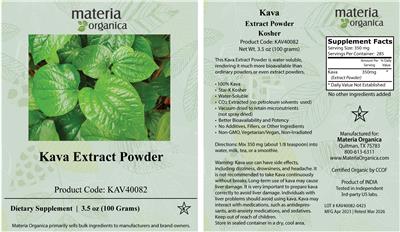
| Kava Extract, Powder | 350 mg | † |
% Daily Values for: Adults and children 4 or more years of age.
Where this label comes from
An original label of the NIH's Dietary Supplement Label Database, entered there on 24 July 2025, shown here as it was entered. The NIH's record · picture of the label (PDF)
General information
- Product name
- Kava Extract Powder
- Brand
- Materia Organica
- Barcode (UPC)
- Not printed
- Net contents
- 3.5 Ounce(s); 100 Gram(s)
- Market status
- On market
- DSLD ID
- 332152
Classification
Label statements
FDA Statement of Identity: Dietary Supplement
Formula: Contains: This Kava Extract Powder is water-soluble, rendering it much more bioavailable than ordinary powders or even extract powders. 100% Kava
Formulation: Does NOT Contain: No additives, fillers, or other ingredients Non-GMO, vegetarian/vegan, non-irradiated
Directions: Directions: Mix 350 mg (about 1/8 teaspoon) into water, milk, tea, or a smoothie.
Precautions: All Other: Warning: Kava use can have side effects, including dizziness, drowsiness, and headache. It is not recommended to take Kava continuously without breaks. Long-term use of kava may cause liver damage. It is very important to prepare kava correctly to avoid liver damage. Individuals with liver problems should avoid using kava.
Precautions: Pregnant or Nursing or Prescription Medications: Kava may interact with medications, such as antidepressants, anti-anxiety medications, and sedatives.
Precautions: Children: Keep out of reach of children.
Storage: Store in sealed container in a dry, cool area.
Brand information
Manufactured for: Materia Organica, Quitman, TX
More labels from Materia Organica
Labels only: each label is shown as printed on the bottle, with no grades, rankings or advice. A label in this database is not an endorsement of the product. Read the label on the bottle you buy: makers change their formulas. Reverse Age Lab is not affiliated with, or endorsed by, the National Institutes of Health or its Office of Dietary Supplements. The original labels come from the NIH’s public-domain data; the labels since are read by us. Search the Dietary Supplement Label Database.