
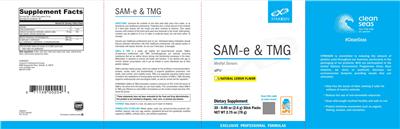
| Calories | 5 | |
| Total Carbohydrate | 1 g | <1% |
| Calcium (as Calcium Carbonate, Calcium Chloride Anhydrous, Calcium Oxide) | 75 mg | 6% |
| Betaine Anhydrous (as Trimethylglycine) | 600 mg | † |
| S-Adenosyl-L-Methionine (as as S-Adenosyl-L-Methionine 1,4 Betandisulfonate) | 400 mg | † |
Other ingredients: Xylitol, Citric Acid, Malic Acid, Stearic Acid, Silica, Lemon Flavor, Natural, Turmeric Extract
% Daily Values for: Adults and children 4 or more years of age.
Where this label comes from
An original label of the NIH's Dietary Supplement Label Database, entered there on 25 September 2025, shown here as it was entered. The NIH's record · picture of the label (PDF)
General information
- Product name
- SAM-e & TMG Natural Lemon Flavor
- Brand
- XYMOGEN
- Barcode (UPC)
- 8 71149 00204 6
- Net contents
- 30 Stick Pack(s); 2.75 Ounce(s); 78 Gram(s)
- Market status
- On market
- DSLD ID
- 335565
Classification
- Supplement form
- Powder
- Product type
- Other Combinations
- Claim types on the label
- All Other, Structure/Function
- Intended for
- Vegan, Vegetarian, Adult (18 - 50 Years), No Allergies, Gluten Free, Dairy Free
Label statements
Directions: Directions: Consume the contents of one stick pack daily away from meals, or as directed by your healthcare professional. Preferably pour a small amount of the contents of a stick pack directly into the mouth and allow contents to dissolve. Then repeat process until contents of the entire stick pack have dissolved in the mouth. Alternatively, contents may be added to 2-4 oz of water or preferred liquid; stir and drink within 15 minutes.
Precautions: All Other: Consult your healthcare professional prior to use.
Precautions: Pregnant or Nursing or Prescription Medications: Individuals taking medication should discuss potential interactions with their healthcare professional.
Precautions: All Other: Use special caution in individuals with bipolar disorder. Do not use if stick pack is damaged.
Formula: Contains: SAM-e & TMG is a sweet, yet slightly tart lemon-flavored powder. SAM-e (S-adenosyl-L-methionine) and TMG (trimethylglycine) are naturally occurring substances that act as methyl donors during vital biochemical processes in the body. Methylation is essential to normal cell health and function. It can decline with age or chronic alcohol consumption, and it can be limited in some individuals due to their genetic makeup. SAM-e donates methyl groups, which are needed for the synthesis of neurotransmitters, proteins, nucleic acids, and phospholipids. It supports glutathione production, liver health, joint comfort, and a healthy mood. TMG is an especially important methyl donor involved in the metabolism of homocysteine and the formation of SAM-e. TMG ultimately supports cardiovascular and neurological health, as well as normal cell-life regulation. XYMOGEN’s SAM-e & TMG formulation contains a minimum of 70% of the SS isomer of SAM-e, the active form the body can use most readily. This concentration makes SAM-e & TMG cost effective as most SAM-e formulations on the market contain less than 44% active SS isomer.
Storage: Storage: Keep closed in a cool, dry place out of reach of children.
Precautions: Children: Storage: Keep closed in a cool, dry place out of reach of children.
Formulation: Does NOT Contain: Formulated to exclude: Wheat, gluten, yeast, soy, animal and dairy products, fish, shellfish, peanuts, tree nuts, egg, sesame, ingredients derived from genetically modified organisms (GMOs), artificial colors, and artificial sweeteners.
Formula: Contains: Methyl donors
FDA Statement of Identity: Dietary Supplement
Brand information
Manufacturer: XYMOGEN, Orlando, FL
More labels from XYMOGEN
Labels only: each label is shown as printed on the bottle, with no grades, rankings or advice. A label in this database is not an endorsement of the product. Read the label on the bottle you buy: makers change their formulas. Reverse Age Lab is not affiliated with, or endorsed by, the National Institutes of Health or its Office of Dietary Supplements. The original labels come from the NIH’s public-domain data; the labels since are read by us. Search the Dietary Supplement Label Database.