
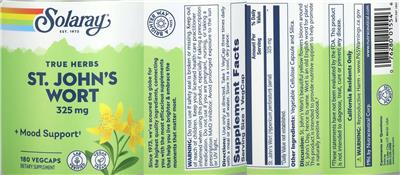
| St. John's Wort (as Hypericum perforatum) | 325 mg | † |
Other ingredients: Cellulose, Silica
% Daily Values for: Adults and children 4 or more years of age.
Where this label comes from
An original label of the NIH's Dietary Supplement Label Database, entered there on 25 September 2025, shown here as it was entered. The NIH's record · picture of the label (PDF)
General information
- Product name
- St. John's Wort 325 mg
- Brand
- Solaray
- Barcode (UPC)
- 0 76280 01554 6
- Net contents
- 180 VegCap(s)
- Market status
- On market
- DSLD ID
- 339037
Classification
Label statements
FDA Statement of Identity: Dietary Supplement
Precautions: All Other: Warning: Do not use if safety seal is broken or missing. Avoid prolonged exposure to the sun or UV light.
Precautions: Children: Keep out of reach of children.
Precautions: Pregnant or Nursing or Prescription Medications: Keep your licensed health care practitioner informed when using this product, especially if taking a prescription medication. Do not use if you are pregnant, nursing, or taking a prescription MAO inhibitor.
Directions: Directions: Use only as directed. Take 1 VegCap three times daily with a meal or glass of water.
Storage: Store in a cool, dry place.
Formula: Contains: Discussion: St. John's Wort's beautiful yellow flowers bloom around St. John's Day, hence its name. Wort is an old English word for plant. This product is intended to provide nutritive support to help promote a naturally positive outlook.
Precautions: All Other: California Residents Only Warning: Reproductive Harm - www.P65Warnings.ca.gov
Brand information
Manufactured by: Nutraceutical Corp.
Comments or questions: Solaray, Salt Lake City, UT, USA
More labels from Solaray
Labels only: each label is shown as printed on the bottle, with no grades, rankings or advice. A label in this database is not an endorsement of the product. Read the label on the bottle you buy: makers change their formulas. Reverse Age Lab is not affiliated with, or endorsed by, the National Institutes of Health or its Office of Dietary Supplements. The original labels come from the NIH’s public-domain data; the labels since are read by us. Search the Dietary Supplement Label Database.