
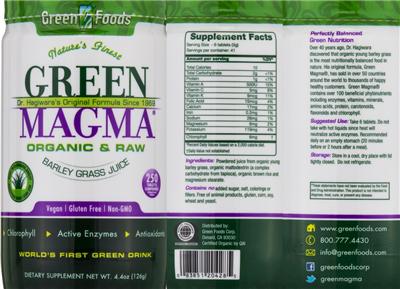
| Total Calories | 10 {Calories} | |
| Total Carbohydrates | 2 g | <1% |
| Protein | 1 g | <1% |
| Vitamin A | 500 IU | 15% |
| Vitamin C | 5 mg | 8% |
| Vitamin K | 9 mcg | 11% |
| Folic Acid | 15 mcg | 4% |
| Calcium | 17 mg | 2% |
| Iron | 0.2 mg | 1% |
| Sodium | 26 mg | 1% |
| Magnesium | 6 mg | 2% |
| Potassium | 119 mg | 4% |
| Chlorophyll | 6 mg | † |
Other ingredients: Powdered juice from organic young barley grass, Maltodextrin, organic Brown Rice, Magnesium Stearate
% Daily Values for: Adults and children 4 or more years of age.
Where this label comes from
An original label of the NIH's Dietary Supplement Label Database, entered there on 25 June 2014, shown here as it was entered. The NIH's record
General information
- Product name
- Green Magma Barely Grass Juice
- Brand
- Green Foods
- Barcode (UPC)
- 0 83851 20428 5
- Net contents
- 4.4 Oz(s); 126 Gram(s)
- Market status
- Off market
- DSLD ID
- 34288
Classification
Label statements
Formulation: Does NOT Contain: Gluten Free
Formula: Contains: Chlorophyll Active Enzymes Antioxidants
FDA Statement of Identity: DIETARY SUPPLEMENT
Formulation: Does NOT Contain: Contains no added sugar, salt, colorings or fillers. Free of animal products, gluten, corn, soy, wheat and yeast.
Directions: Suggested Use: Take 6 tablets. Do not take with hot liquids since heat will neutralize active enzymes. Recommended daily on and empty stomach (20 minutes before or 2 hours after a meal).
Storage: Storage: Store in a cool, dry place with lid tightly closed. Do no refrigerate.
Formula: Contains: BARLEY GRASS JUICE
Brand information
Distributed by: Green Foods Corp., Oxnard, CA
More labels from Green Foods
Labels only: each label is shown as printed on the bottle, with no grades, rankings or advice. A label in this database is not an endorsement of the product. Read the label on the bottle you buy: makers change their formulas. Reverse Age Lab is not affiliated with, or endorsed by, the National Institutes of Health or its Office of Dietary Supplements. The original labels come from the NIH’s public-domain data; the labels since are read by us. Search the Dietary Supplement Label Database.