
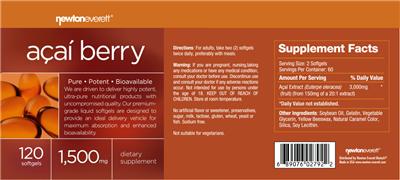
| Acai extract | 3,000 mg | † |
| from 150mg of a 20:1 {Acai} Extract | 150 mg |
Other ingredients: Soybean Oil, Gelatin, Vegetable Glycerin, yellow Beeswax, natural Caramel color, Silica, Soy Lecithin
% Daily Values for: Adults and children 4 or more years of age.
Where this label comes from
An original label of the NIH's Dietary Supplement Label Database, entered there on 25 June 2014, shown here as it was entered. The NIH's record
General information
- Product name
- Acai Berry 1500 mg
- Brand
- NewtonEverett
- Barcode (UPC)
- 6 89076 02792 2
- Net contents
- 120 Softgel(s)
- Market status
- Off market
- DSLD ID
- 34659
Classification
- Supplement form
- Softgel Capsule
- Product type
- Botanical
- Claim types on the label
- All Other
- Intended for
- Adult (18 - 50 Years), Gluten Free, Dairy Free, Sugar Free
Label statements
FDA Statement of Identity: dietary supplement
Directions: Directions: For adults, take two (2) softgels twice daily, preferably with meals.
Precautions: Pregnant or Nursing or Prescription Medications: Warning: If you are pregnant, nursing, taking any medications or have any medical condition, consult your doctor before use.
Precautions: All Other: Discontinue use and consult your doctor if any adverse reactions occur.
Precautions: Children: Not intended for use by persons under the age of 18. KEEP OUT OF REACH OF CHILDREN.
Storage: Store at room temperature.
Formulation: Does NOT Contain: No artificial flavor or sweetener, preservatives, sugar, milk, lactose, gluten, wheat, yeast or fish. Sodium free.
Precautions: All Other: Not suitable for vegetarians.
Brand information
Distributed by: Newton-Everett Biotech
More labels from NewtonEverett
Labels only: each label is shown as printed on the bottle, with no grades, rankings or advice. A label in this database is not an endorsement of the product. Read the label on the bottle you buy: makers change their formulas. Reverse Age Lab is not affiliated with, or endorsed by, the National Institutes of Health or its Office of Dietary Supplements. The original labels come from the NIH’s public-domain data; the labels since are read by us. Search the Dietary Supplement Label Database.