
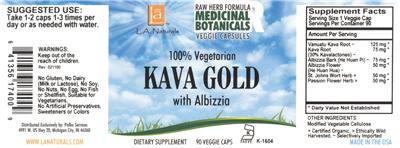
| Vanuatu KavaVanuatu Kava PlantPart: root Note: selectively imported | 125 mg | † |
| Kava (as Kavalactones)Kava (Form: 30% Kavalactones) PlantPart: root Note: selectively imported | 75 mg | † |
| Albizia (as He Huan Pi)Albizia (Form: He Huan Pi) PlantPart: bark Genus: Albizia Note: selectively imported | 75 mg | † |
| Albizia (as He Huan Hua)Albizia (Form: He Huan Hua) PlantPart: flower Genus: Albizia Note: selectively imported | 50 mg | † |
| St. John's WortSt. John's Wort PlantPart: herb Note: certified organic | 50 mg | † |
| Passion FlowerPassion Flower PlantPart: herb Note: ethically wild harvested | 50 mg | † |
Other ingredients: Modified Vegetable Cellulose
% Daily Values for: Adults and children 4 or more years of age.
Where this label comes from
An original label of the NIH's Dietary Supplement Label Database, entered there on 25 July 2014, shown here as it was entered. The NIH's record
General information
- Product name
- Kava Gold
- Brand
- L.A. Naturals
- Barcode (UPC)
- 6 41356 17400 9
- Net contents
- 90 Veggie Cap(s)
- Market status
- On market
- DSLD ID
- 34959
Classification
Label statements
Formulation: Does NOT Contain: No Gluten, No Dairy (Milk or Lactose), No Soy, No Nuts, No Egg, No Fish or Shellfish, Suitable for Vegetarians, No Artificial Preservatives, Sweeteners or Colors
Formula: Contains: with Albizzia
FDA Statement of Identity: DIETARY SUPPLEMENT
Directions: SUGGESTED USE: Take 1-2 caps 1-3 times per day or as needed with water.
Precautions: Children: WARNINGS: Keep out of the reach of children.
Brand information
Distributed Exclusively by: Palko Services, Michigan City, IN
More labels from L.A. Naturals
Labels only: each label is shown as printed on the bottle, with no grades, rankings or advice. A label in this database is not an endorsement of the product. Read the label on the bottle you buy: makers change their formulas. Reverse Age Lab is not affiliated with, or endorsed by, the National Institutes of Health or its Office of Dietary Supplements. The original labels come from the NIH’s public-domain data; the labels since are read by us. Search the Dietary Supplement Label Database.