
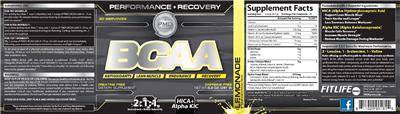
| Calories | 5 {Calories} | |
| Total Carbohydrates | 2 g | 1% |
| Vitamin C (as Ascorbic Acid) | 125 mg | 208% |
| Vitamin B6 (as Pyridoxine Hydrochloride)Vitamin B6 (Form: as Pyridoxine Hydrochloride) | 3 mg | 150% |
| Vitamin B12 (as Cyanocobalamin)Vitamin B12 (Form: as Cyanocobalamin) | 100 mcg | 1,667% |
| Calcium (as Calcium Silicate)Calcium (Form: as Calcium Silicate) | 23 mg | 2% |
| Potassium (as as Potassium Citrate)Potassium (Form: as Potassium Citrate) | 72 mg | 2% |
| Branched-Chain Amino Acids | 4 g | † |
| Leucine | 2 g | |
| Isoleucine | 1 g | |
| Valine | 1 g | |
| Amino Catalyst Blend | 2 g | † |
| Taurine | ||
| Alanine | ||
| Glycine | ||
| Serine | ||
| Threonine | ||
| HICA | ||
| Alpha KIC | ||
| Hydra-Pump Blend | 250 mg | † |
| Potassium Citrate | ||
| Salvia miltiorrhiza (as and Salvianolic Acid, containing Tanshinones)Salvia miltiorrhiza (Form: containing Tanshinones, and Salvianolic Acid) Genus: Salvia Species: miltiorrhiza | ||
| Bioenergy Ribose (as D-Ribose, Powder) | ||
| CoQ-10 |
Other ingredients: Citric Acid, Natural and Artificial flavors, Sucralose, Waxy Maize, Acesulfame Potassium, FD&C Yellow 5
% Daily Values for: Adults and children 4 or more years of age.
Where this label comes from
An original label of the NIH's Dietary Supplement Label Database, entered there on 25 July 2014, shown here as it was entered. The NIH's record
General information
- Product name
- BCAA Lemonade
- Brand
- PMD Platinum
- Barcode (UPC)
- 8 11020 90181 5
- Net contents
- 9.2 oz.; 261 Gram(s)
- Market status
- Off market
- DSLD ID
- 35889
Classification
- Supplement form
- Powder
- Product type
- Other Combinations
- Claim types on the label
- All Other, Structure/Function
- Intended for
- Adult (18 - 50 Years), Gluten Free
Label statements
Precautions: All Other: Discard after expiration date.
Precautions: Children: WARNING: KEEP OUT OF REACH OF CHILDREN.
Precautions: Children: Not for use by those under the age of 18.
Precautions: All Other: Do not exceed recommended dose.
Precautions: Pregnant or Nursing or Prescription Medications: Do not use if you are pregnant or nursing.
Precautions: All Other: Before consuming seek advice from a health care professional if you are unaware of your current health condition. Discontinue use and immediate consult your healthcare professional if you experience any adverse reaction to this product. Do not use if tamper resistant seal is broken.
Storage: STORE IN A COOL, DRY PLACE AND AVOID EXCESSIVE HEAT.
Formulation: Does NOT Contain: CREATINE FREE
FDA Statement of Identity: DIETARY SUPPLEMENT
Formulation: Does NOT Contain: CAFFEINE FREE
Formula: Contains: HICA+ Alpha KIC
Formula: Contains: Contains Soy.
Precautions: Allergies: Contains Soy.
Formulation: Does NOT Contain: Gluten Free.
Formula: Contains: Formulated with 2 Powerful Ingredients: HICA (Alpha-Hydroxyisocaproic Acid ~Support Lean Muscle Mass ~Train Harder and Longer ~Less Soreness Between Workouts Alpha KIC (Alpha Ketoisocaproate) ~Muscle Cells Recovery ~Increase Muscle Strength ~Reduce Muscle Damage During Workouts
Directions: SUGGESTED USE: FOR PRE-WORKOUT: For activity less than 1 hour in duration, mix 1 scoop of PMD's BCAA with 8-10 oz. of cold water 30 minutes before exercise/training to maximize your performance and endurance. FOR INTRA-WORKOUT: For activity lasting more than 1 hour, mix 1 scoop of PMD's BCAA with 8-10 oz. of cold water during your exercise/training (ie. Running, Cycling, Swimming, etc...) and drink throughout. FOR POST WORKOUT: Mix 1 scoop of PMD's BCAA with 8-10 oz. of cold water and use immediately following your exercise/training to maximize recovery and fight fatigue.
Brand information
Manufacturer: FitLife Brands, Omaha, NE
More labels from PMD Platinum
Labels only: each label is shown as printed on the bottle, with no grades, rankings or advice. A label in this database is not an endorsement of the product. Read the label on the bottle you buy: makers change their formulas. Reverse Age Lab is not affiliated with, or endorsed by, the National Institutes of Health or its Office of Dietary Supplements. The original labels come from the NIH’s public-domain data; the labels since are read by us. Search the Dietary Supplement Label Database.