
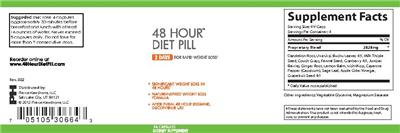
| Proprietary Blend | 2,828 mg | † |
| Dandelion | ||
| Uva Ursi | ||
| BuchuBuchu PlantPart: leaves Note: 4:1 | ||
| Milk Thistle | ||
| Couch Grass | ||
| Fennel | ||
| CranberryCranberry Note: 4:1 | ||
| Juniper | ||
| Ginger | ||
| Lemon Balm | ||
| Irish Moss | ||
| Cayenne Pepper | ||
| Sage | ||
| Apple Cider Vinegar | ||
| GrapefruitGrapefruit PlantPart: seed Note: 4:1 |
Other ingredients: Vegetable Glycerine, Magnesium Stearate
% Daily Values for: Adults and children 4 or more years of age.
Where this label comes from
An original label of the NIH's Dietary Supplement Label Database, entered there on 10 October 2014, shown here as it was entered. The NIH's record
General information
- Product name
- 48 Hour Diet Pill
- Brand
- Pierce Hawthone
- Barcode (UPC)
- 7 05105 30664 3
- Net contents
- 16 Capsule(s)
- Market status
- Off market
- DSLD ID
- 36987
Classification
Label statements
Precautions: All Other: Never exceed 8 capsules daily. Do not take for more than 2 consecutive days.
Directions: ~ AFTER INITIAL 48 HOUR REGIME, DISCONTINUE USE
FDA Statement of Identity: DIETARY SUPPLEMENT
Directions: Suggested Use: Take 4 capsules approximately 30 minutes before breakfast and lunch with at least 16 ounces of water.
Brand information
Distributed by: Pierce Hawthone, LLC, Salt Lake City, UT
More labels from Pierce Hawthone
Labels only: each label is shown as printed on the bottle, with no grades, rankings or advice. A label in this database is not an endorsement of the product. Read the label on the bottle you buy: makers change their formulas. Reverse Age Lab is not affiliated with, or endorsed by, the National Institutes of Health or its Office of Dietary Supplements. The original labels come from the NIH’s public-domain data; the labels since are read by us. Search the Dietary Supplement Label Database.