
| Docosahexaenoic Acid | 250 mg | † |
Other ingredients: Gelatin, Water, Glycerin, Polysorbate 80
% Daily Values for: Adults and children 4 or more years of age.
Where this label comes from
An original label of the NIH's Dietary Supplement Label Database, entered there on 10 October 2014, shown here as it was entered. The NIH's record
General information
- Product name
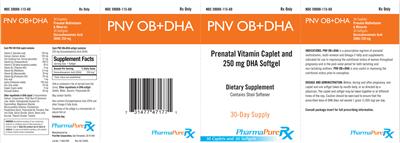
- PNV OB+DHA Softgel
- Brand
- PharmaPure Rx
- Barcode (UPC)
- 7 31477 47177 1
- Net contents
- 30 Softgel(s)
- Market status
- On market
- DSLD ID
- 37180
Classification
- Supplement form
- Softgel Capsule
- Product type
- Fat/Fatty Acid
- Claim types on the label
- All Other
- Intended for
- Pregnant Women, Adult Female (18 - 50 Years), Lactating
Label statements
Formula: Contains: 250 mg DHA Softgel
FDA Statement of Identity: Dietary Supplement
Formula: Contains: Contains Stool Softener
Directions: DOSAGE AND ADMINISTRATION: Before, during and after pregnancy, one caplet and one softgel taken by mouth daily, or as directed by a physician. The caplet and softgel may be taken together or at different times of the day.
Precautions: All Other: Caution should be exercised to ensure that the prescribed dose of DHA does not exceed 1 gram (1,000 mg) per day.
Formula: Contains: 30 Softgels: Docosahexaenoic Acid (DHA) 250 mg
Formula: Contains: Each PNV OB+DHA softgel contains: 250 mg Docosahexaenoic Acid (DHA)
Formula: Contains: May contain Vanillin.
Formula: Contains: Also contains Eicosapentaenoic Acid (EPA) and other Omega-3 Fatty Acids.
Formula: Contains: Contains Soy.
Precautions: Allergies: Contains Soy.
Brand information
Manufactured by: PureTek Corporation, San Fernando, CA
More labels from PharmaPure Rx
Labels only: each label is shown as printed on the bottle, with no grades, rankings or advice. A label in this database is not an endorsement of the product. Read the label on the bottle you buy: makers change their formulas. Reverse Age Lab is not affiliated with, or endorsed by, the National Institutes of Health or its Office of Dietary Supplements. The original labels come from the NIH’s public-domain data; the labels since are read by us. Search the Dietary Supplement Label Database.