
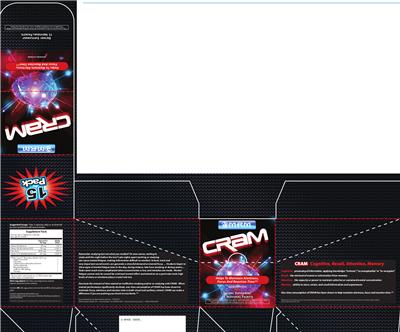
| Vitamin B3 (as Niacin) | 30 mg | 150% |
| Vitamin B6 (as Pyridoxine Hydrochloride) | 30 mg | 1,500% |
| Folic Acid | 400 mcg | 100% |
| Vitamin B12 (as Methylcobalamin) | 60 mcg | 1,000% |
| CRAM Fusion(TM)CRAM Fusion(TM) Note: Proprietary Blend | 1,623 mg | † |
| Acetyl L-Carnitine | † | |
| L-Tyrosine | † | |
| L-Alpha Glycerylphosphorylcholine | † | |
| Choline Bitartrate | † | |
| Phosphatidylserine | † | |
| Caffeine USPCaffeine USP Note: 60mg | 60 mg | † |
| Naringin | † |
Other ingredients: Rice Flour, Magnesium Stearate, Capsule
% Daily Values for: Adults and children 4 or more years of age.
Where this label comes from
An original label of the NIH's Dietary Supplement Label Database, entered there on 10 October 2014, shown here as it was entered. The NIH's record
General information
- Product name
- CRAM
- Brand
- MRM
- Barcode (UPC)
- 6 09492 56006
- Net contents
- 15 Individual Packet(s)
- Market status
- On market
- DSLD ID
- 37258
Classification
- Supplement form
- Capsule
- Product type
- Other Combinations
- Claim types on the label
- Structure/Function
- Intended for
- Adult (18 - 50 Years), Gluten Free, Dairy Free
Label statements
Directions: Suggested Usage: Take 3 capsules daily or as directed by your qualified healthcare provider.
Formulation: Does NOT Contain: Contains NO milk, egg, peanut, tree nut, fish, shellfish, wheat, gluten or yeast.
Formula: Contains: Contains ingredients derived from soy. Contains Niacin which may cause a harmless flushing sensation in some individuals.
Precautions: Allergies: Contains ingredients derived from soy.
Formula: Contains: CONTAINS CAFFEINE
FDA Statement of Identity: DIETARY SUPPLEMENT
Brand information
Formulated by & Manufactured for: MRM, Oceanside, CA, USA
More labels from MRM
Labels only: each label is shown as printed on the bottle, with no grades, rankings or advice. A label in this database is not an endorsement of the product. Read the label on the bottle you buy: makers change their formulas. Reverse Age Lab is not affiliated with, or endorsed by, the National Institutes of Health or its Office of Dietary Supplements. The original labels come from the NIH’s public-domain data; the labels since are read by us. Search the Dietary Supplement Label Database.