
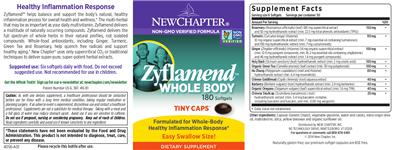
| Rosemary | 150 mg | † |
| Rosemary supercritical extract | 100 mg | |
| min. 22.5 mg Total Phenolic Antioxidants | 22.5 mg | |
| Turmeric Essential Oil (as containing Turmerones)Turmeric Essential Oil (Form: containing Turmerones) | <=7 mg | |
| min. 7 mg Curcuminoids | 7 mg | |
| min. 12.9 mg Pungent Compounds | 12.9 mg | |
| Ginger essential Oils (as containing Zingiberene)Ginger essential Oils (Form: containing Zingiberene) | <=16.2 mg | |
| 50 mg {Rosemary} hydroethanolic extract | 50 mg | |
| organic {Turmeric} supercritical extract | 10 mg | |
| 100 mg {Turmeric} hydroethanolic extract | 100 mg | |
| Turmeric | 110 mg | † |
| Ginger | 100 mg | † |
| 54 mg organic {Ginger} supercritical extract | 54 mg | |
| 46 mg {Ginger} hydroethanolic extract | 46 mg | |
| min. 1.4 mg Pungent Compounds | 1.4 mg | |
| min. 2 mg Ursolic Acid | 2 mg | |
| min. 30 mg Polyphenols | 30 mg | |
| min. 6.4 mg Resveratrols | 6.4 mg | |
| min. 2.4 mg Berberine | 2.4 mg | |
| min. 1.6 mg TPA | 1.6 mg | |
| min. 3.4 mg Baicalein complex (as including Baicalein, and Baicalin)min. 3.4 mg Baicalein complex (Form: including Baicalein, and Baicalin) | 3.4 mg | |
| min. 0.08 mg Wogonin | 0.08 mg | |
| Holy Basil (Ocimum sanctum) (leaf) hydroethanolic extract | 100 mg | † |
| organic Green Tea (Camellia sinensis) (leaf) extract | 100 mg | † |
| Hu Zhang (Polygonum cuspidatum) (root and rhizome) hydroethanolic extract | 80 mg | † |
| Chinese Goldthread (Coptis chinensis) (root) aqueous extract | 40 mg | † |
| Barberry (Berberis vulgaris) (root) hydroethanolic extract | 40 mg | † |
| organic Oregano (Origanum vulgare) (leaf) supercritical extract | 40 mg | † |
| Chinese Skullcap (Scutellaria baicalensis) (root) hydroethanolic extract | 20 mg | † |
Other ingredients: Capsule, extra-virgin Olive Oil, Maltodextrin, Silica, yellow Beeswax, organic Sunflower Oil
% Daily Values for: Adults and children 4 or more years of age.
Where this label comes from
An original label of the NIH's Dietary Supplement Label Database, entered there on 25 November 2014, shown here as it was entered. The NIH's record
General information
- Product name
- Zyflamend Whole Body Tiny Caps
- Brand
- New Chapter
- Barcode (UPC)
- Not printed
- Net contents
- 180 Softgel(s)
- Market status
- Off market
- DSLD ID
- 39474
Classification
- Supplement form
- Softgel Capsule
- Product type
- Botanical
- Claim types on the label
- All Other, Structure/Function
- Intended for
- Adult (18 - 50 Years), Gluten Free
Label statements
Directions: Suggested use: Six softgels daily with food.
Precautions: All Other: Do not exceed suggested use.
Precautions: Children: Not recommended for use in children.
Precautions: Pregnant or Nursing or Prescription Medications: Caution: As with any dietary supplement, a healthcare professional should be contacted before use for those with a long term medical condition, taking regular medication or planning surgery.
Precautions: All Other: If an adverse event is experienced, discontinue use and contact a healthcare professional. Supplements are not a substitute for medical therapy. Taking with a meal and a full glass of water may reduce stomach upset. Avoid use if you are sensitive to caffeine.
Precautions: Pregnant or Nursing or Prescription Medications: Do not use if pregnant, nursing or considering pregnancy.
Precautions: Children: Keep out of reach of children.
Precautions: All Other: Read ingredients carefully and avoid use if known sensitivity to any ingredient.
FDA Statement of Identity: DIETARY SUPPLEMENT
Formulation: Does NOT Contain: Naturally gluten free; our premium softgel capsules are BSE free.
Brand information
Distributed by: NEW CHAPTER, INC., BRATTLEBORO, VT
More labels from New Chapter
Labels only: each label is shown as printed on the bottle, with no grades, rankings or advice. A label in this database is not an endorsement of the product. Read the label on the bottle you buy: makers change their formulas. Reverse Age Lab is not affiliated with, or endorsed by, the National Institutes of Health or its Office of Dietary Supplements. The original labels come from the NIH’s public-domain data; the labels since are read by us. Search the Dietary Supplement Label Database.