
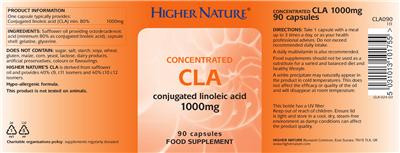
| Conjugated Linoleic AcidConjugated Linoleic Acid (Alt. Name: CLA) Note: min. 80% | 1,000 mg |
Other ingredients: Safflower oil, Capsule Shell
% Daily Values for: Adults and children 4 or more years of age.
Where this label comes from
An original label of the NIH's Dietary Supplement Label Database, entered there on 23 January 2015, shown here as it was entered. The NIH's record
General information
- Product name
- Concentrated CLA 1000 mg
- Brand
- Higher Nature
- Barcode (UPC)
- 5 031013 101755
- Net contents
- 90 Capsule(s)
- Market status
- Off market
- DSLD ID
- 41382
Classification
- Supplement form
- Capsule
- Product type
- Non-Nutrient/Non-Botanical
- Claim types on the label
- All Other
- Intended for
- Adult (18 - 50 Years), No Allergies, Gluten Free, Dairy Free, Sugar Free
Label statements
Formulation: Does NOT Contain: DOES NOT CONTAIN: sugar, salt, starch, soya, wheat, gluten, maize, corn, yeast, lactose, dairy products, artificial preservatives, colours or flavourings.
Formula: Contains: HIGHER NATURE’S CLA is derived from safflower oil and provides 40% c9, t11 isomers and 40% t10 c12 isomers.
Formula: Contains: conjugated linoleic acid
FDA Statement of Identity: FOOD SUPPLEMENT
Directions: DIRECTIONS: Take 1 capsule with a meal up to 3 times a day, or as your health professional advises. Do not exceed recommended daily intake. A daily multivitamin is also recommended.
Precautions: Children: Keep out of reach of children.
Storage: Ensure lid is tight and store in a cool, dry, steam free environment as damp conditions can affect the product quality.
Brand information
Manufacturer: Higher Nature, Burwash Common, East Sussex, UK
More labels from Higher Nature
Labels only: each label is shown as printed on the bottle, with no grades, rankings or advice. A label in this database is not an endorsement of the product. Read the label on the bottle you buy: makers change their formulas. Reverse Age Lab is not affiliated with, or endorsed by, the National Institutes of Health or its Office of Dietary Supplements. The original labels come from the NIH’s public-domain data; the labels since are read by us. Search the Dietary Supplement Label Database.