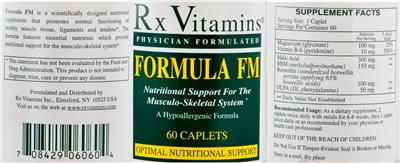
| Magnesium (as Magnesium Glycinate) | 100 mg | 25% |
| Vitamin B6 (as Pyridoxine) | 10 mg | 500% |
| Malic Acid | 300 mg | † |
| MSM | 150 mg | † |
| Boswellin (as standardized Boswellia serrata)Boswellin (Form: standardized Boswellia serrata (Form: supplying 65% Boswellic Acids) Genus: Boswellia Species: serrata) | 100 mg | † |
| DL-Phenylalanine | 50 mg | † |
% Daily Values for: Adults and children 4 or more years of age.
Where this label comes from
An original label of the NIH's Dietary Supplement Label Database, entered there on 25 February 2015, shown here as it was entered. The NIH's record
General information
- Product name
- Formula FM
- Brand
- Rx Vitamins
- Barcode (UPC)
- 7 08429 06060 4
- Net contents
- 60 Caplet(s)
- Market status
- On market
- DSLD ID
- 42054
Classification
- Supplement form
- Other (e.g. tea bag)
- Product type
- Other Combinations
- Claim types on the label
- All Other, Structure/Function
- Intended for
- Adult (18 - 50 Years), No Allergies
Label statements
Precautions: All Other: Formula FM is a scientifically designed nutritional supplement that promotes normal functioning of healthy muscle tissue, ligaments and tendons*. The formula features essential nutrients which provide nutritional support for the musculo-skeletal system.
Precautions: All Other: Do Not Use If Tamper-Evident Seal is Broken or Missing.
Storage: Store in a cool, dry place
Directions: Recommended Usage: As a dietary supplement, 2 caplets twice daily with meals for 6-8 weeks, then 1 caplet twice daily or as recommended by your physician or health care professional.
Precautions: Children: KEEP OUT OR THE REACH OF CHILDREN.
Brand information
Formulated and Distributed by: Rx Vitamins Inc., Elmsford, NY, USA
More labels from Rx Vitamins
Labels only: each label is shown as printed on the bottle, with no grades, rankings or advice. A label in this database is not an endorsement of the product. Read the label on the bottle you buy: makers change their formulas. Reverse Age Lab is not affiliated with, or endorsed by, the National Institutes of Health or its Office of Dietary Supplements. The original labels come from the NIH’s public-domain data; the labels since are read by us. Search the Dietary Supplement Label Database.