
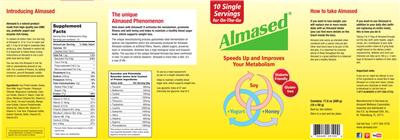
| Calories | 180 {Calories} | |
| Calories from Fat | 9 {Calories} | |
| Total Fat | 1 g | 1.5% |
| Saturated Fat | 0.5 g | 2.5% |
| Trans Fat | 0 g | † |
| Polyunsaturated Fat | 0.1 g | † |
| Monounsaturated Fat | 0.4 g | † |
| Cholesterol | 0 mg | 0% |
| Sodium | 340 mg | 15% |
| Potassium | 500 mg | 14% |
| Total Carbohydrates | 15 g | 6% |
| Dietary Fiber | 0.5 g | 2% |
| Sugar | 15 g | † |
| Protein | 27 g | 54% |
| Vitamin A | 794 IU | 16% |
| Vitamin C | 16 mg | 27% |
| Vitamin E | 6 IU | 20% |
| Thiamine (as Vitamin B1) | 0.5 mg | 33% |
| Riboflavin (as Vitamin B2) | 0.6 mg | 35% |
| Vitamin B6 | 0.7 mg | 35% |
| Calcium | 215 mg | 22% |
| Iron | 4.9 mg | 27% |
Other ingredients: Soy Protein isolate, Honey, Skim Milk Yogurt powder, Potassium Chloride, Magnesium Carbonate, Calcium Citrate, Vitamin C, Niacin, Riboflavin, Vitamin E, Zinc Oxide, Ferrous Fumarate, Manganese Sulfate, Calcium Pantothenate, Vitamin B2, Vitamin B6, Vitamin B1, Vitamin A, Folic Acid, Potassium Iodide, Sodium Selenite, Biotin, Vitamin D3, Vitamin B12
% Daily Values for: Adults and children 4 or more years of age.
Where this label comes from
An original label of the NIH's Dietary Supplement Label Database, entered there on 25 February 2015, shown here as it was entered. The NIH's record
General information
- Product name
- Almased
- Brand
- Almased
- Barcode (UPC)
- 6 88449 26100 0
- Net contents
- 17.6 oz.; 500 Gram(s)
- Market status
- On market
- DSLD ID
- 42433
Classification
- Supplement form
- Powder
- Product type
- Multi-Vitamin and Mineral (MVM)
- Claim types on the label
- All Other, Structure/Function
- Intended for
- Adult (18 - 50 Years)
Label statements
Formula: Contains: Almased is a natural product made from high-quality non-GMO soy, probiotic yogurt and enzyme-rich honey.
Directions: To replace an entire meal, mix one bag of Almased in 10 to 12 oz of water and add 1-2 tsp of oil high in essential fatty acids (e.g. olive, flaxseed or walnut oil). It is important to follow these mixing instructions as Almased is not a complete food item by itself. You can also mix Almased in low fat milk or unsweetened almond or soy milk. For a variety of flavors, try adding cinnamon, ground flaxseeds, vanilla extract or unsweetened cocoa powder.
Formulation: Does NOT Contain: Gluten-free
Formula: Contains: Soy + Honey + Yogurt
Storage: Store in a cool and dry place.
Directions: How to take Almased If you want to lose weight, you will replace one or more meals daily with an Almased shake (you can find more details on the insert inside the box). Almased only works as intended when combined with a calorie-reduced diet. Other food items have to be part of the diet plan. It is important to consume plenty of fluids throughout the day.
Precautions: Allergies: Important note: If you are (or might be) allergic to one of the ingredients or would like to take Almased on a long-term basis, please consult your physician or health care professional or call toll-free at 1-877-ALMASED (1-877-256-2733).
Directions: If you want to use Almased in addition to your daily diet (without replacing an entire meal), this is how you do it: Taking 2 to 5 Tbsp of Almased throughout the day (with some liquids, yogurt, cereal, etc.) contributes to your daily required protein intake (0.8 g/kg body weight based on the dietary protein requirements). Athletes who work out intensely can take up to 100 g (= 2 servings) of Almased in addition to their daily diet.
Formulation: Does NOT Contain: Almased contains no artificial fillers, flavors, added sugars, preservatives or stimulants.
Brand information
Manufactured in Germany by: Almased Wellness Corporation
Imported and distributed in the U.S. by: Almased USA, Inc., St. Petersburg, FL
More labels from Almased
Labels only: each label is shown as printed on the bottle, with no grades, rankings or advice. A label in this database is not an endorsement of the product. Read the label on the bottle you buy: makers change their formulas. Reverse Age Lab is not affiliated with, or endorsed by, the National Institutes of Health or its Office of Dietary Supplements. The original labels come from the NIH’s public-domain data; the labels since are read by us. Search the Dietary Supplement Label Database.