
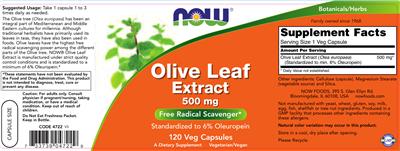
| Olive leaf extract (as standardized to min. Oleuropein)Olive leaf extract (Form: standardized to min. 6% Oleuropein) PlantPart: leaf Genus: Olea Species: europaea | 500 mg | † |
Other ingredients: Cellulose, Magnesium Stearate, Silica
% Daily Values for: Adults and children 4 or more years of age.
Where this label comes from
An original label of the NIH's Dietary Supplement Label Database, entered there on 25 March 2015, shown here as it was entered. The NIH's record
General information
- Product name
- Olive Leaf Extract 500 mg
- Brand
- NOW
- Barcode (UPC)
- 7 33739 04722 9
- Net contents
- 120 Veg Capsule(s)
- Market status
- On market
- DSLD ID
- 42992
Classification
Label statements
FDA Statement of Identity: A Dietary Supplement
Formulation: Does NOT Contain: Not manufactured with yeast, wheat, gluten, soy, milk, egg, fish, shellfish or tree nut ingredients.
Precautions: Allergies: Not manufactured with yeast, wheat, gluten, soy, milk, egg, fish, shellfish or tree nut ingredients. Produced in a GMP facility that processes other ingredients containing these allergens.
Storage: Store in a cool, dry place after opening.
Directions: Suggested Usage: Take 1 capsule 1 to 3 times daily as needed.
Precautions: All Other: Caution: For adults only.
Precautions: Pregnant or Nursing or Prescription Medications: Consult physician if pregnant/nursing, taking medication, or have a medical condition.
Precautions: Children: Keep out of reach of children.
Precautions: All Other: Do Not Eat Freshness Packet. Keep in Bottle.
Formula: Contains: Standardized to 6% Oleuropein
Brand information
Manufacturer: NOW Foods, Bloomingdale, IL, USA
More labels from NOW
Labels only: each label is shown as printed on the bottle, with no grades, rankings or advice. A label in this database is not an endorsement of the product. Read the label on the bottle you buy: makers change their formulas. Reverse Age Lab is not affiliated with, or endorsed by, the National Institutes of Health or its Office of Dietary Supplements. The original labels come from the NIH’s public-domain data; the labels since are read by us. Search the Dietary Supplement Label Database.