
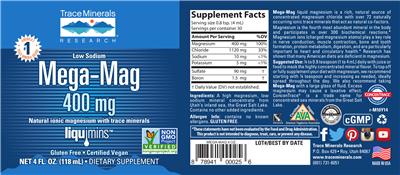
| Magnesium | 400 mg | 100% |
| Chloride | 1,120 mg | 33% |
| Sodium | 10 mg | <1% |
| Potassium | 5 mg | <1% |
| Sulfate | 90 mg | † |
| Boron | 1.5 mg | † |
Other ingredients: a high Magnesium, low Sodium Mineral concentrate
% Daily Values for: Adults and children 4 or more years of age.
Where this label comes from
An original label of the NIH's Dietary Supplement Label Database, entered there on 25 March 2015, shown here as it was entered. The NIH's record
General information
- Product name
- Mega-Mag 400 mg
- Brand
- Trace Minerals Research
- Barcode (UPC)
- 8 78941 00025 6
- Net contents
- 4 fl. Oz.; 118 mL
- Market status
- Off market
- DSLD ID
- 43843
Classification
Label statements
Formula: Contains: Natural ionic magnesium with trace minerals
Formulation: Does NOT Contain: Gluten Free
FDA Statement of Identity: DIETARY SUPPLEMENT
Formulation: Does NOT Contain: Allergen Info: contains no known allergens. GLUTEN FREE.
Formula: Contains: Mega-Mag liquid magnesium is a rich, natural source of concentrated magnesium chloride with over 72 naturally occurring ionic trace minerals that act as natural co-factors.
Precautions: All Other: Excess magnesium may cause a laxative effect.
Directions: Suggested Use: 1/4 to 0.8 teaspoon (1 to 4 mL) daily with juice or food to mask the highly concentrated mineral flavor. To top off or fully supplement your diet with magnesium, we recommend starting with 1/4 teaspoon and increasing as needed, ideally spread throughout the day. We also recommend taking Mega-Mag with a large glass of fluid.
Formulation: Does NOT Contain: Contains no other added ingredients.
Brand information
Manufacturer: Trace Minerals Research, Roy, Utah
More labels from Trace Minerals Research
Labels only: each label is shown as printed on the bottle, with no grades, rankings or advice. A label in this database is not an endorsement of the product. Read the label on the bottle you buy: makers change their formulas. Reverse Age Lab is not affiliated with, or endorsed by, the National Institutes of Health or its Office of Dietary Supplements. The original labels come from the NIH’s public-domain data; the labels since are read by us. Search the Dietary Supplement Label Database.