
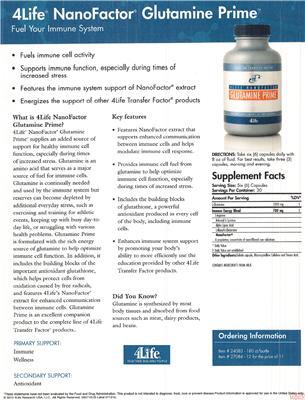
| L-Glutamine | 2,300 mg | † |
| Immune Energy Blend | 780 mg | † |
| L-Arginine | ||
| N-Acetyl L-Cysteine | ||
| Alpha Lipoic Acid | ||
| L-Alanyl-L-Glutamine | ||
| NanoFactor (as A proprietary concentrate of nano-filtered Cow Colostrum)NanoFactor (Form: A proprietary concentrate of nano-filtered Cow Colostrum) |
Other ingredients: Gelatin, Microcrystalline Cellulose, Stearic Acid
% Daily Values for: Adults and children 4 or more years of age.
Where this label comes from
An original label of the NIH's Dietary Supplement Label Database, entered there on 22 May 2015, shown here as it was entered. The NIH's record
General information
- Product name
- Nanofactor Glutamine Prime
- Brand
- 4Life
- Barcode (UPC)
- Not printed
- Net contents
- 180 Capsule(s)
- Market status
- On market
- DSLD ID
- 44531
Classification
- Supplement form
- Capsule
- Product type
- Other Combinations
- Claim types on the label
- Nutrient, Structure/Function
- Intended for
- Adult (18 - 50 Years)
Label statements
Formula: Contains: Glutamine is an amino acid that serves as a major source of fuel for immune cells.
Formula: Contains: Glutamine Prime is formulated with the rich energy source of glutamine to help optimize immune cell function.
Formula: Contains: Includes the building blocks of glutathione, a powerful antioxidant produced in every cell of the body, including immune cells.
Directions: DIRECTIONS: Take six (6) capsules daily with 8 oz fluid. For best results, take three (3) capsules, morning and evening.
Formula: Contains: CONTAINS INGREDIENTS FROM MILK.
Precautions: Allergies: CONTAINS INGREDIENTS FROM MILK.
FDA Statement of Identity: DIETARY SUPPLEMENT
Brand information
{Not Present}: 4Life
More labels from 4Life
Labels only: each label is shown as printed on the bottle, with no grades, rankings or advice. A label in this database is not an endorsement of the product. Read the label on the bottle you buy: makers change their formulas. Reverse Age Lab is not affiliated with, or endorsed by, the National Institutes of Health or its Office of Dietary Supplements. The original labels come from the NIH’s public-domain data; the labels since are read by us. Search the Dietary Supplement Label Database.