
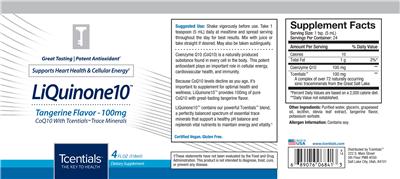
| Calories | 10 {Calories} | |
| Total Fat | 1 g | 2% |
| Coenzyme Q10 | 100 mg | † |
| Tcentials(TM)Tcentials(TM) Note: A complex of over 72 naturally occurring ionic traceminerals from the Great Salt Lake. | 100 mg | † |
Other ingredients: purified Water, Glycerin, Grapeseed Oil, Lecithin, Stevia leaf extract, Tangerine flavor, Potassium Sorbate
% Daily Values for: Adults and children 4 or more years of age.
Where this label comes from
An original label of the NIH's Dietary Supplement Label Database, entered there on 22 May 2015, shown here as it was entered. The NIH's record
General information
- Product name
- LiQuinone10 Tangerine Flavor - 100 mg
- Brand
- Tcentials
- Barcode (UPC)
- 6 89076 06841 3
- Net contents
- 4 fl. Oz.; 118 mL
- Market status
- On market
- DSLD ID
- 45784
Classification
- Supplement form
- Liquid
- Product type
- Other Combinations
- Claim types on the label
- Nutrient, Structure/Function
- Intended for
- Vegan, Vegetarian, Adult (18 - 50 Years), Gluten Free
Label statements
Directions: Suggested Use: Shake vigorously before use. Take 1 teaspoon (5 mL) daily at mealtime and spread serving throughout the day for best results. Mix with juice or take straight if desired. May also be taken sublingually.
Formula: Contains: LiQuinone10(TM) provides 100mg of pure CoQ10 with great-tasting tangerine flavor.
Formulation: Does NOT Contain: Gluten Free.
Precautions: Allergies: Allergen Information: Contains soy.
Formula: Contains: Allergen Information: Contains soy.
Formula: Contains: CoQ10 with Tcentials(TM) Trace Minerals
FDA Statement of Identity: Dietary Supplement
Brand information
Distributed by: Tcentials, Salt Lake City, Utah
More labels from Tcentials
Labels only: each label is shown as printed on the bottle, with no grades, rankings or advice. A label in this database is not an endorsement of the product. Read the label on the bottle you buy: makers change their formulas. Reverse Age Lab is not affiliated with, or endorsed by, the National Institutes of Health or its Office of Dietary Supplements. The original labels come from the NIH’s public-domain data; the labels since are read by us. Search the Dietary Supplement Label Database.