
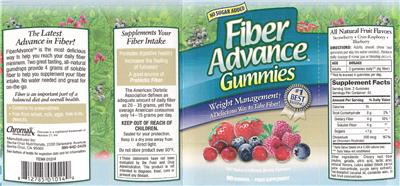
| Calories | 15 {Calories} | |
| Total Carbohydrates | 6 g | 2% |
| Dietary Fiber | 4 g | 16% |
| Soluble Fiber | 4 g | † |
| Sugar | <1 g | † |
| Chromium (as as Chromium Picolinate)Chromium (Form: as Chromium Picolinate) | 200 mcg | 167% |
Other ingredients: Chicory root fiber, Gelatin, Citric Acid, Lactic Acid, Natural flavors, colors added, fractionated Coconut Oil, Carnauba Wax, Lo Han fruit concentrate
% Daily Values for: Adults and children 4 or more years of age.
Where this label comes from
An original label of the NIH's Dietary Supplement Label Database, entered there on 25 June 2015, shown here as it was entered. The NIH's record
General information
- Product name
- Fiber Advance Gummies
- Brand
- Santa Cruz Nutritionals
- Barcode (UPC)
- 8 12785 01014 9
- Net contents
- 90 Gummie(s)
- Market status
- Off market
- DSLD ID
- 46121
Classification
- Supplement form
- Gummy or Jelly
- Product type
- Mineral
- Claim types on the label
- Nutrient, All Other, Structure/Function
- Intended for
- Adult (18 - 50 Years), Dairy Free
Label statements
Precautions: Children: KEEP OUT OF REACH OF CHILDREN.
Storage: Keep in a dry area away from direct light. Do not store product over 80(0)F.
FDA Statement of Identity: Fiber Supplement
Directions: DIRECTIONS: Adults should chew two gummies per day (no water needed). Reduce daily dosage if minor gas or bloating occurs.
Directions: AGE DOSAGE Adults 2 gummies daily (4g fiber) Not to exceed 4 gummies per day.
Formulation: Does NOT Contain: - Contains no preservatives. - Free from wheat, milk, eggs, tree nuts, peanuts.
Formulation: Does NOT Contain: NO SUGAR ADDED
Brand information
Manufactured by: Santa Cruz Nutritionals, Santa Cruz, CA
More labels from Santa Cruz Nutritionals
Labels only: each label is shown as printed on the bottle, with no grades, rankings or advice. A label in this database is not an endorsement of the product. Read the label on the bottle you buy: makers change their formulas. Reverse Age Lab is not affiliated with, or endorsed by, the National Institutes of Health or its Office of Dietary Supplements. The original labels come from the NIH’s public-domain data; the labels since are read by us. Search the Dietary Supplement Label Database.