
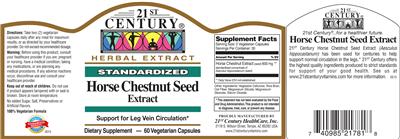
| Horse Chestnut extractHorse Chestnut extract PlantPart: seed Genus: Aesculus Species: hippocastanum Note: standardized concentrate of | 600 mg | † |
Other ingredients: Vegetable Cellulose, Rice Bran, Oat Fiber, Magnesium Silicate, Magnesium Stearate, Silicon Dioxide
% Daily Values for: Adults and children 4 or more years of age.
Where this label comes from
An original label of the NIH's Dietary Supplement Label Database, entered there on 25 June 2015, shown here as it was entered. The NIH's record
General information
- Product name
- Horse Chestnut Seed Extract
- Brand
- 21st Century
- Barcode (UPC)
- 7 40985 21781 8
- Net contents
- 60 Vegetarian Capsule(s)
- Market status
- Off market
- DSLD ID
- 46266
Classification
Label statements
Directions: Directions: Take two (2) vegetarian capsules daily after any meal for maximum results, or as directed by your healthcare provider. Do not exceed recommended dosage.
Directions: Warning: Before using this product, consult your healthcare provider if you are: pregnant or nursing, have a medical condition, taking any medications, or are planning any medical procedures.
Precautions: All Other: If any adverse reactions occur, discontinue use and consult your healthcare provider.
Precautions: Children: Keep out of reach of children.
Precautions: All Other: Do not use if product appears tampered with or seal is broken.
Storage: Store at room temperature.
Formulation: Does NOT Contain: No added Sugar, Salt, Preservatives or Artificial Flavors.
FDA Statement of Identity: Dietary Supplement
Brand information
PROUDLY MANUFACTURED BY: 21st Century HealthCare, Inc., Tempe, AZ, USA
More labels from 21st Century
Labels only: each label is shown as printed on the bottle, with no grades, rankings or advice. A label in this database is not an endorsement of the product. Read the label on the bottle you buy: makers change their formulas. Reverse Age Lab is not affiliated with, or endorsed by, the National Institutes of Health or its Office of Dietary Supplements. The original labels come from the NIH’s public-domain data; the labels since are read by us. Search the Dietary Supplement Label Database.