
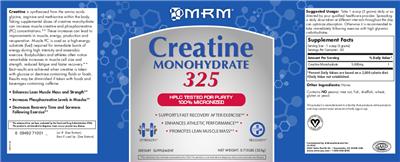
| Creatine Monohydrate | 5,000 mg | † |
% Daily Values for: Adults and children 4 or more years of age.
Where this label comes from
An original label of the NIH's Dietary Supplement Label Database, entered there on 25 June 2015, shown here as it was entered. The NIH's record
General information
- Product name
- Creatine Monohydrate 325
- Brand
- MRM
- Barcode (UPC)
- 6 09492 71001
- Net contents
- 0.715 lbs; 325 Gram(s)
- Market status
- Off market
- DSLD ID
- 46390
Classification
- Supplement form
- Powder
- Product type
- Non-Nutrient/Non-Botanical
- Claim types on the label
- Structure/Function
- Intended for
- Vegan, Vegetarian, Adult (18 - 50 Years), Gluten Free
Label statements
FDA Statement of Identity: Dietary Supplement
Directions: Suggested Usage: Take 1 scoop (5 grams) daily or as directed by your qualified healthcare provider. Spreading a daily dose taken at different intervals throughout the day can optimize absorption. Otherwise it is recommended to take immediately following exercise with high glycemic carbohydrates.
Formulation: Does NOT Contain: Contains NO egg, peanut, tree nut, fish, shellfish, wheat, gluten or yeast.
Precautions: Allergies: This product is manufactured in a facility that produces other products and may contain trace amounts of dairy or soy.
Brand information
Formulated by & Manufactured for: MRM, Oceanside, CA, USA
More labels from MRM
Labels only: each label is shown as printed on the bottle, with no grades, rankings or advice. A label in this database is not an endorsement of the product. Read the label on the bottle you buy: makers change their formulas. Reverse Age Lab is not affiliated with, or endorsed by, the National Institutes of Health or its Office of Dietary Supplements. The original labels come from the NIH’s public-domain data; the labels since are read by us. Search the Dietary Supplement Label Database.