
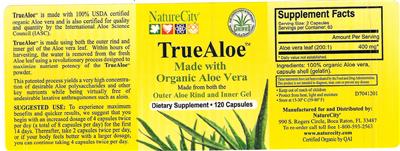
| Aloe veraAloe vera PlantPart: leaf Genus: Aloe Species: vera Note: 200:1 | 400 mg | † |
Other ingredients: 100% organic Aloe vera, Capsule Shell
% Daily Values for: Adults and children 4 or more years of age.
Where this label comes from
An original label of the NIH's Dietary Supplement Label Database, entered there on 24 July 2015, shown here as it was entered. The NIH's record
General information
- Product name
- TrueAloe
- Brand
- NatureCity
- Barcode (UPC)
- Not printed
- Net contents
- 120 Capsule(s)
- Market status
- Off market
- DSLD ID
- 47378
Classification
Label statements
Directions: Suggested Use: To experience maximum benefits and quicker results, we suggest that you begin with an increased dosage of 4 capsules twice per day (a total of 8 capsules per day) for the first 14 days. Thereafter, take 2 capsules twice per day, or if your body feels better with a larger dosage, you can continue taking 4 capsule twice per day.
Formula: Contains: Made with organic aloe vera
Precautions: Children: ~ Keep out of reach of children
Storage: ~ Protect from heat, light and moisture ~ Store at 15-30(0) C (59-86(0) F)
Formula: Contains: This patented process yields a very high concentration of desirable Aloe polysaccharides and other key nutrients while being virtually free of undesirable laxative anthraquinones such as aloin.
Formulation: Does NOT Contain: This patented process yields a very high concentration of desirable Aloe polysaccharides and other key nutrients while being virtually free of undesirable laxative anthraquinones such as aloin.
FDA Statement of Identity: Dietary Supplement
Brand information
Manufactured for and Distributed by:: NatureCity, Boca Raton, FL
More labels from NatureCity
Labels only: each label is shown as printed on the bottle, with no grades, rankings or advice. A label in this database is not an endorsement of the product. Read the label on the bottle you buy: makers change their formulas. Reverse Age Lab is not affiliated with, or endorsed by, the National Institutes of Health or its Office of Dietary Supplements. The original labels come from the NIH’s public-domain data; the labels since are read by us. Search the Dietary Supplement Label Database.