
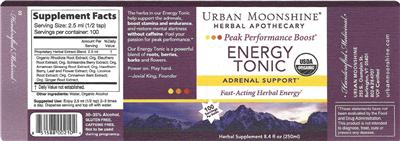
| Proprietary Herbal Extract Blend (Herb/Botanical) | 2.5 mL | † |
| organic Rhodiola root extract | ||
| org. Eleuthero root extract | ||
| org. Schisandra berry extract | ||
| org. American Ginseng root extract | ||
| org. Hawthorn berry, leaf and flower extract | ||
| org. Licorice root extract | ||
| org. Cinnamon bark extract | ||
| org. Ginger root extract |
Other ingredients: Water, organic Alcohol
% Daily Values for: Adults and children 4 or more years of age.
Where this label comes from
An original label of the NIH's Dietary Supplement Label Database, entered there on 25 September 2015, shown here as it was entered. The NIH's record
General information
- Product name
- Energy Tonic
- Brand
- Urban Moonshine
- Barcode (UPC)
- 8 51588 00210 4
- Net contents
- 8.4 fl. Oz.; 250 mL
- Market status
- On market
- DSLD ID
- 50490
Classification
Label statements
Directions: Suggested Use: Enjoy 2.5.ml (1/2 tsp) 2-3 times a day. Dispense serving and top off with water.
Formula: Contains: 30-35% Alcohol.
Formulation: Does NOT Contain: Gluten Free. Caffeine Free.
Precautions: Pregnant or Nursing or Prescription Medications: Not to be used during pregnancy.
Brand information
Manufacturer: Urban Moonshine, Burlington, VT
More labels from Urban Moonshine
Labels only: each label is shown as printed on the bottle, with no grades, rankings or advice. A label in this database is not an endorsement of the product. Read the label on the bottle you buy: makers change their formulas. Reverse Age Lab is not affiliated with, or endorsed by, the National Institutes of Health or its Office of Dietary Supplements. The original labels come from the NIH’s public-domain data; the labels since are read by us. Search the Dietary Supplement Label Database.