
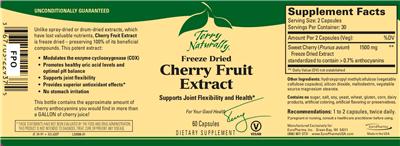
| Sweet Cherry (Prunus avium) freeze dried extract (as standardized to contain > Anthocyanins)Sweet Cherry (Prunus avium) freeze dried extract (Form: standardized to contain > 0.7% Anthocyanins) Genus: Prunus Species: avium | 1,500 mcg | † |
Other ingredients: Hydroxypropyl Methylcellulose, Silicon Dioxide, Maltodextrin, Vegetable Source Magnesium Stearate
% Daily Values for: Adults and children 4 or more years of age.
Where this label comes from
An original label of the NIH's Dietary Supplement Label Database, entered there on 22 October 2015, shown here as it was entered. The NIH's record
General information
- Product name
- Freeze Dried Cherry Fruit Extract
- Brand
- Terry Naturally
- Barcode (UPC)
- Not printed
- Net contents
- 60 Capsule(s)
- Market status
- On market
- DSLD ID
- 51689
Classification
Label statements
Formula: Contains: Unlike spray-dried or drum-dried extracts, which have lost valuable nutrients, Cherry Fruit Extract is freeze dried – preserving 100% of its beneficial compounds.
Formula: Contains: This bottle contains the approximate amount of cherry anthocyanins you would find in more than a GALLON of cherry juice!
FDA Statement of Identity: Dietary Supplement
Formulation: Does NOT Contain: Contains no sugar, salt, soy, yeast, wheat, gluten, corn, dairy products, artificial coloring, artificial flavoring or preservatives.
Directions: Recommendations: 1 to 2 capsules, twice daily.
Precautions: Pregnant or Nursing or Prescription Medications: If pregnant or nursing, consult a healthcare practitioner before using.
Brand information
Manufactured exclusively for:: EuroPharma Inc.,, Green Bay, WI
More labels from Terry Naturally
Labels only: each label is shown as printed on the bottle, with no grades, rankings or advice. A label in this database is not an endorsement of the product. Read the label on the bottle you buy: makers change their formulas. Reverse Age Lab is not affiliated with, or endorsed by, the National Institutes of Health or its Office of Dietary Supplements. The original labels come from the NIH’s public-domain data; the labels since are read by us. Search the Dietary Supplement Label Database.