
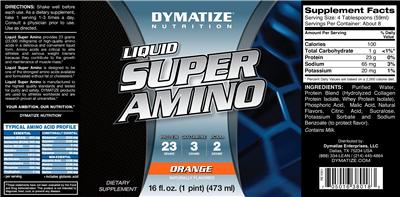
| Calories | 100 {Calories} | |
| Total Carbohydrates | 1 g | <1% |
| Protein | 23 g | 46% |
| Sodium | 65 mg | 3% |
| Potassium | 20 mg | 1% |
Other ingredients: purified Water, Protein Blend, Phosphoric Acid, Malic Acid, Natural flavors, Citric Acid, Sucralose, Potassium Sorbate, Sodium Benzoate
% Daily Values for: Adults and children 4 or more years of age.
Where this label comes from
An original label of the NIH's Dietary Supplement Label Database, entered there on 24 November 2015, shown here as it was entered. The NIH's record
General information
- Product name
- Liquid Super Amino Orange
- Brand
- Dymatize Nutrition
- Barcode (UPC)
- 7 05016 38018 3
- Net contents
- 16 fl. Oz.; 1 Pint(s); 473 mL
- Market status
- Off market
- DSLD ID
- 53091
Classification
- Supplement form
- Liquid
- Product type
- Amino acid/Protein
- Claim types on the label
- Nutrient, Structure/Function
- Intended for
- Adult (18 - 50 Years)
Label statements
Directions: DIRECTIONS: Shake well before each use. As a dietary supplement, take 1 serving 1-3 times a day.
Precautions: All Other: Consult a physician prior to use.
Directions: Use as directed.
Formula: Contains: Liquid Super Amino provides 23 grams (23,000 milligrams) of high-quality amino acids in a delicious and convenient liquid form.
Formulation: Does NOT Contain: Liquid Super Amino is designed to be one of the strongest amino acids available and formulated without fat or cholesterol.
Formula: Contains: Protein 23 grams Glutamine 3 grams BCAAs 2 grams
FDA Statement of Identity: DIETARY SUPPLEMENT
Formula: Contains: Contains Milk.
Precautions: Allergies: Contains Milk.
Brand information
Distributed by:: Dymatize Enterprises, LLC, Dallas, TX, USA
More labels from Dymatize Nutrition
Labels only: each label is shown as printed on the bottle, with no grades, rankings or advice. A label in this database is not an endorsement of the product. Read the label on the bottle you buy: makers change their formulas. Reverse Age Lab is not affiliated with, or endorsed by, the National Institutes of Health or its Office of Dietary Supplements. The original labels come from the NIH’s public-domain data; the labels since are read by us. Search the Dietary Supplement Label Database.