
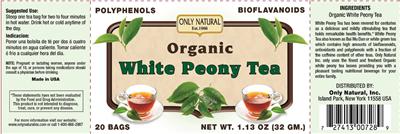
| organic White Peony Tea |
% Daily Values for: Adults and children 4 or more years of age.
Where this label comes from
An original label of the NIH's Dietary Supplement Label Database, entered there on 24 November 2015, shown here as it was entered. The NIH's record
General information
- Product name
- White Peony Tea
- Brand
- Only Natural
- Barcode (UPC)
- 7 27413 00728 9
- Net contents
- 20 Bag(s); 1.13 Oz(s); 32 Gram(s)
- Market status
- On market
- DSLD ID
- 53492
Classification
- Supplement form
- Other (e.g. tea bag)
- Product type
- Botanical
- Claim types on the label
- All Other, Structure/Function
- Intended for
- Adult (18 - 50 Years)
Label statements
Precautions: Children: Note: Pregnant or lactating women, anyone under the age of 18, or persons taking medications should consult a physician before drinking.
Precautions: Pregnant or Nursing or Prescription Medications: Note: Pregnant or lactating women, anyone under the age of 18, or persons taking medications should consult a physician before drinking.
Formula: Contains: Polyphenols Bioflavanoids
Directions: Suggested Use: Steep one tea bag for two to four minutes in hot water. Drink hot or cold anytime of the day.
Formula: Contains: White Peony Tea also known as Bai Mu Dan or white green tea which contains high amounts of bioflavanoids, antioxidants and polyphenols with a fraction of the caffeine content of other teas.
Formula: Contains: Only Natural Inc. only uses the finest and freshest organic white peony tea leaves providing you with a pleasant tasting nutritional beverage for your entire family.
Brand information
Distributed by:: Only Natural, Inc., Island Park, New York, USA
More labels from Only Natural
Labels only: each label is shown as printed on the bottle, with no grades, rankings or advice. A label in this database is not an endorsement of the product. Read the label on the bottle you buy: makers change their formulas. Reverse Age Lab is not affiliated with, or endorsed by, the National Institutes of Health or its Office of Dietary Supplements. The original labels come from the NIH’s public-domain data; the labels since are read by us. Search the Dietary Supplement Label Database.