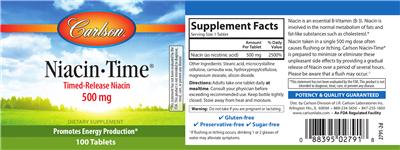
| Niacin (as Nicotinic Acid)Niacin (Form: as Nicotinic Acid) | 500 mg | 2,500% |
Other ingredients: Stearic Acid, Microcrystalline Cellulose, Carnauba Wax, Hydroxypropylcellulose, Magnesium Stearate, Silicon Dioxide
% Daily Values for: Adults and children 4 or more years of age.
Where this label comes from
An original label of the NIH's Dietary Supplement Label Database, entered there on 23 December 2015, shown here as it was entered. The NIH's record
General information
- Product name
- Niacin-Time
- Brand
- Carlson
- Barcode (UPC)
- 0 88395 02791 8
- Net contents
- 100 Tablet(s)
- Market status
- Off market
- DSLD ID
- 54362
Classification
- Supplement form
- Tablet or Pill
- Product type
- Vitamin
- Claim types on the label
- All Other, Structure/Function
- Intended for
- Adult (18 - 50 Years), Gluten Free, Sugar Free
Label statements
Formula: Contains: Timed-Release Niacin 500 mg
FDA Statement of Identity: DIETARY SUPPLEMENT
Precautions: Pregnant or Nursing or Prescription Medications: Directions: Adults take one tablet daily at mealtime.
Precautions: All Other: Consult your physician before exceeding recommended use.
Storage: Keep bottle tightly closed. Store away from heat and moisture.
Precautions: Pregnant or Nursing or Prescription Medications: Warning: Do not take if you are pregnant or lactating.
Formulation: Does NOT Contain: Gluten-free Preservative-free Sugar-free
Precautions: Pregnant or Nursing or Prescription Medications: If flushing or itching occurs, drinking 1 or 2 glasses of water may alleviate symptoms.
Brand information
Dist. by: Carlson Division of J.R. Carlson Laboratories, Inc., Arlington Hts., IL
More labels from Carlson
Labels only: each label is shown as printed on the bottle, with no grades, rankings or advice. A label in this database is not an endorsement of the product. Read the label on the bottle you buy: makers change their formulas. Reverse Age Lab is not affiliated with, or endorsed by, the National Institutes of Health or its Office of Dietary Supplements. The original labels come from the NIH’s public-domain data; the labels since are read by us. Search the Dietary Supplement Label Database.