
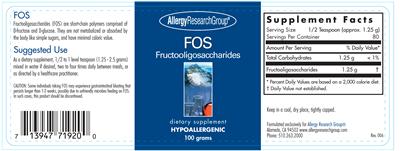
| Total Carbohydrates | 1.25 g | <1% |
| Fructooligosaccharides | 1.25 g | † |
Other ingredients: Absolutely None
% Daily Values for: Adults and children 4 or more years of age.
Where this label comes from
An original label of the NIH's Dietary Supplement Label Database, entered there on 23 December 2015, shown here as it was entered. The NIH's record
General information
- Product name
- FOS Fructooligosaccharides
- Brand
- Allergy Research Group
- Barcode (UPC)
- 7 13947 71920 0
- Net contents
- 100 Gram(s)
- Market status
- Off market
- DSLD ID
- 54488
Classification
Label statements
Directions: Suggested Use As a dietary supplement, 1/2 to 1 level teaspoon (1.25-2.5 grams) mixed in water if desired, two to four times daily between meals, or as directed by a healthcare practitioner.
Precautions: All Other: CAUTION: Some individuals taking FOS may experience gastrointestinal bloating that persists longer than 1-2 weeks, possibly due to unfriendly microbes feeding on FOS. In such cases, this product should be discontinued.
FDA Statement of Identity: Dietary Supplement
Storage: Keep in a cool, dry place, tightly capped.
Brand information
Formulated exclusively for: Allergy Research Group, Alameda, CA
More labels from Allergy Research Group
Labels only: each label is shown as printed on the bottle, with no grades, rankings or advice. A label in this database is not an endorsement of the product. Read the label on the bottle you buy: makers change their formulas. Reverse Age Lab is not affiliated with, or endorsed by, the National Institutes of Health or its Office of Dietary Supplements. The original labels come from the NIH’s public-domain data; the labels since are read by us. Search the Dietary Supplement Label Database.