
| Vitamin A (as Vitamin A Acetate) | 1,500 IU | 30% |
| Vitamin C (as Magnesium Ascorbate, Manganese Ascorbate) | 150 mg | 250% |
| Vitamin D (as Cholecalciferol) | 400 IU | 100% |
| Vitamin E (as D-Alpha-Tocopheryl Succinate)Vitamin E (Form: as D-Alpha Tocopheryl Succinate) | 50 IU | 167% |
| Vitamin K1 | 80 mcg | 100% |
| Thiamine (as Thiamine Hydrochloride) | 12.5 mg | 833% |
| Riboflavin | 12.5 mg | 735% |
| Niacin (as Niacinamide) | 25 mg | 125% |
| Vitamin B6 (as Pyridoxine Hydrochloride) | 12.5 mg | 625% |
| Folic Acid | 200 mcg | 50% |
| Vitamin B12 (as Hydroxocobalamin) | 500 mcg | 8,333% |
| Biotin | 300 mcg | 100% |
| Pantothenic Acid (as Calcium D-Pantothenate) | 50 mg | 500% |
| Calcium (as Calcium Carbonate, Calcium Citrate, Dibasic Calcium Phosphate Dihydrate) | 244 mg | 24% |
| Iron (as Iron Malate) | 7.5 mg | 42% |
| Phosphorus (as Dibasic Calcium Phosphate Dihydrate) | 97 mg | 10% |
| Iodine (as Potassium Iodide) | 150 mcg | 100% |
| Magnesium (as Magnesium Ascorbate, Magnesium Oxide) | 25.4 mg | 6% |
| Zinc (as Zinc Citrate) | 7.5 mg | 50% |
| Selenium (as Selenomethionine) | 100 mcg | 143% |
| Copper (as Copper Gluconate) | 1 mg | 50% |
| Manganese (as Manganese Ascorbate) | 2.5 mg | 125% |
| Chromium (as Chromium Picolinate) | 120 mcg | 100% |
| Molybdenum (as Potassium Molybdate) | 75 mcg | 100% |
| Potassium (as Potassium Citrate) | 12.5 mg | <1% |
| Boron (as Boron Hydrolysed Vegetable Protein Chelate) | 500 mcg | † |
| Nickel (as Nickel Sulfate Hexahydrate) | 12.5 mcg | † |
| Silicon (as Silicon Dioxide) | 13 mg | † |
| Vanadium (as Vanadyl Sulfate) | 25 mcg | † |
| Choline (as Choline Bitartrate) | 20 mg | † |
| Inositol | 5 mg | † |
Other ingredients: Magnesium Stearate, Acacia, Hypromellose, Croscarmellose Sodium, Titanium Dioxide, Glycerin
% Daily Values for: Adults and children 4 or more years of age.
Where this label comes from
An original label of the NIH's Dietary Supplement Label Database, entered there on 25 January 2016, shown here as it was entered. The NIH's record
General information
- Product name
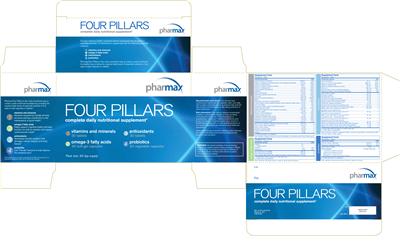
- Vitamins and Minerals
- Brand
- Pharmax
- Barcode (UPC)
- 883196 20350
- Net contents
- 30 Tablet(s)
- Market status
- On market
- DSLD ID
- 55816
Classification
- Supplement form
- Tablet or Pill
- Product type
- Other Combinations
- Claim types on the label
- All Other, Structure/Function
- Intended for
- Adult (18 - 50 Years)
Label statements
Directions: Recommended adult intake: One serrated strip, containing two tablets and two capsules, taken once daily with a protein containing meal or as professionally directed. Take at least 2-3 hours or after taking antibiotics or other medications.
Precautions: All Other: Risk information: If you have an immune-compromised condition or auto-immune disease; or if you are taking corticosteroids, do not use.
Precautions: Pregnant or Nursing or Prescription Medications: If you are pregnant or breastfeeding, consult your healthcare practitioner prior to use.
Precautions: All Other: If symptoms of digestive upset occur, worsen or persist beyond three days; or if you develop symptoms of liver trouble, discontinue use and consult your healthcare practitioner.
Precautions: Children: WARNING: Accidental overdose of iron-containing products is a leading cause of fatal poisoning in children under 6. Keep this product out of reach of children. In case of accidental overdose, call a doctor or poison control center immediately.
FDA Statement of Identity: complete daily nutritional supplement*
Precautions: All Other: Safety-sealed for your protection and for product freshness.Do not use if the blister pack has been tampered with.
Storage: Store in a cool, dry place.
Brand information
Made in the UK for: Seroyal USA, Pittsburgh, PA
More labels from Pharmax
Labels only: each label is shown as printed on the bottle, with no grades, rankings or advice. A label in this database is not an endorsement of the product. Read the label on the bottle you buy: makers change their formulas. Reverse Age Lab is not affiliated with, or endorsed by, the National Institutes of Health or its Office of Dietary Supplements. The original labels come from the NIH’s public-domain data; the labels since are read by us. Search the Dietary Supplement Label Database.