
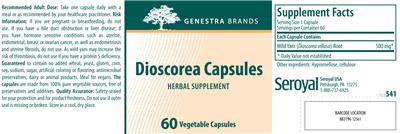
| Wild Yam | 500 mg | † |
Other ingredients: Hypromellose, Cellulose
% Daily Values for: Adults and children 4 or more years of age.
Where this label comes from
An original label of the NIH's Dietary Supplement Label Database, entered there on 25 January 2016, shown here as it was entered. The NIH's record
General information
- Product name
- Dioscorea Capsules
- Brand
- Genestra Brands
- Barcode (UPC)
- 883196 12561
- Net contents
- 60 Vegetable Capsule(s)
- Market status
- On market
- DSLD ID
- 56052
Classification
Label statements
Directions: Recommended Adult Dose: Take one capsule daily with a meal or as recommended by your healthcare practitioner.
Precautions: Pregnant or Nursing or Prescription Medications: Risk Information: If you are pregnant or breastfeeding, do not use.
Precautions: All Other: If you have a bile duct obstruction or liver disease; if you have hormone sensitive conditions such as uterine, endometrial, breast or ovarian cancer, as well as endometriosis and uterine fibroids, do not use. As wild yam may increase the risk of thrombosis, do not use if you have a protein S deficiency.
Formulation: Does NOT Contain: Guaranteed to contain no added wheat, yeast, gluten, corn, soy, sodium, sugar, artificial coloring or flavoring, antimicrobial preservatives, dairy or animal products.
Formulation: Does NOT Contain: The capsules are made from 100% pure vegetable sources, free of preservatives and additives.
Precautions: Allergies: Quality Assurance: Safety-sealed for your protection and for product freshness. Do not use if outer seal is missing or broken.
Storage: Store in a cool, dry place.
FDA Statement of Identity: HERBAL SUPPLEMENT
Brand information
Manufacturer: Seroyal USA, Pittsburgh, PA
More labels from Genestra Brands
Labels only: each label is shown as printed on the bottle, with no grades, rankings or advice. A label in this database is not an endorsement of the product. Read the label on the bottle you buy: makers change their formulas. Reverse Age Lab is not affiliated with, or endorsed by, the National Institutes of Health or its Office of Dietary Supplements. The original labels come from the NIH’s public-domain data; the labels since are read by us. Search the Dietary Supplement Label Database.