
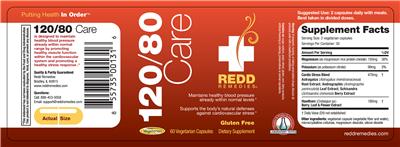
| Magnesium (as as Magnesium Rice Protein Chelate)Magnesium (Form: as Magnesium Rice Protein Chelate) | 150 mg | 38% |
| Potassium (as as Potassium Citrate)Potassium (Form: as Potassium Citrate) | 99 mg | 3% |
| Cardio Stress Blend | 470 mg | † |
| Astragalus (Astragalus membranaceus) root extract | ||
| Andrographis (Andrographis paninculata) leaf extract | ||
| Schisandra (Schisandra chinensis) berry extract | ||
| Hawthorn (Crataegus sp.) berry, leaf & flower extract | 180 mg | † |
Other ingredients: Vegetarian Capsule, Microcrystalline Cellulose, Magnesium Stearate, Silicon Dioxide
% Daily Values for: Adults and children 4 or more years of age.
Where this label comes from
An original label of the NIH's Dietary Supplement Label Database, entered there on 25 January 2016, shown here as it was entered. The NIH's record
General information
- Product name
- 120/80 Care
- Brand
- Redd Remedies
- Barcode (UPC)
- 8 55735 00131 6
- Net contents
- 60 Vegetarian Capsule(s)
- Market status
- On market
- DSLD ID
- 56139
Classification
Label statements
Formulation: Does NOT Contain: Gluten Free
FDA Statement of Identity: Dietary Supplement
Precautions: Pregnant or Nursing or Prescription Medications: Warning: If pregnant, nursing, or taking prescription drugs, discuss all products used with a healthcare practitioner.
Formulation: Does NOT Contain: Contains no: sugar, sodium, yeast, wheat, gluten, corn, dairy products, artificial flavoring or coloring, preservatives or animal ingredients
Directions: Suggested Use: 2 capsules daily with meals. Best taken in divided doses.
Brand information
Quality & Purity Guaranteed: Redd Remedies, Bradley, IL
More labels from Redd Remedies
Labels only: each label is shown as printed on the bottle, with no grades, rankings or advice. A label in this database is not an endorsement of the product. Read the label on the bottle you buy: makers change their formulas. Reverse Age Lab is not affiliated with, or endorsed by, the National Institutes of Health or its Office of Dietary Supplements. The original labels come from the NIH’s public-domain data; the labels since are read by us. Search the Dietary Supplement Label Database.