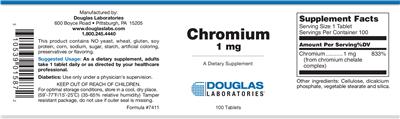
| Chromium (as from Chromium Chelate Complex)Chromium (Form: from Chromium Chelate Complex) | 1 mg | 833% |
Other ingredients: Cellulose, Dicalcium Phosphate, Vegetable Stearate, Silica
% Daily Values for: Adults and children 4 or more years of age.
Where this label comes from
An original label of the NIH's Dietary Supplement Label Database, entered there on 23 February 2016, shown here as it was entered. The NIH's record
General information
- Product name
- Chromium 1 mg
- Brand
- Douglas Laboratories
- Barcode (UPC)
- 3 10539 01587 2
- Net contents
- 100 Tablet(s)
- Market status
- Off market
- DSLD ID
- 56470
Classification
- Supplement form
- Tablet or Pill
- Product type
- Mineral
- Claim types on the label
- All Other
- Intended for
- Adult (18 - 50 Years), Gluten Free, Sugar Free
Label statements
Formulation: Does NOT Contain: This product contains NO yeast, wheat, gluten, soy protein, corn, sodium, sugar, starch, artificial coloring, preservatives or flavoring.
Directions: Suggested Usage: As a dietary supplement, adults take 1 tablet daily or as directed by your healthcare professional.
Precautions: Children: KEEP OUT OF REACH OF CHILDREN.
Storage: For optimal storage conditions, store in a cool, dry place. (59(0)-77(0)F/15(0)-25(0)C) (35-65% relative humidity)
Precautions: All Other: Tamper resistant package, do not use if outer seal is missing.
FDA Statement of Identity: A Dietary Supplement
Brand information
Manufactured by:: Douglas Laboratories, Pittsburgh, PA, USA
More labels from Douglas Laboratories
Labels only: each label is shown as printed on the bottle, with no grades, rankings or advice. A label in this database is not an endorsement of the product. Read the label on the bottle you buy: makers change their formulas. Reverse Age Lab is not affiliated with, or endorsed by, the National Institutes of Health or its Office of Dietary Supplements. The original labels come from the NIH’s public-domain data; the labels since are read by us. Search the Dietary Supplement Label Database.