
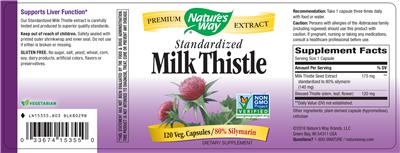
| Milk Thistle seed extract (as standardized to Silymarin)Milk Thistle seed extract (Form: standardized to 80% Silymarin Note: 140 mg) PlantPart: seed | 175 mg | † |
| Blessed Thistle | 120 mg |
Other ingredients: plant-derived Capsule, Cellulose
% Daily Values for: Adults and children 4 or more years of age.
Where this label comes from
An original label of the NIH's Dietary Supplement Label Database, entered there on 24 June 2016, shown here as it was entered. The NIH's record
General information
- Product name
- Standardized Milk Thistle
- Brand
- Nature's Way
- Barcode (UPC)
- 0 33674 15355 0
- Net contents
- 120 Veg. Capsule(s)
- Market status
- Off market
- DSLD ID
- 60711
Classification
Label statements
Precautions: Children: Keep out of reach of children.
Precautions: All Other: Safety sealed with printed outer shrinkwrap and inner seal. Do not use if either is broken or missing.
Formulation: Does NOT Contain: Gluten free. No sugar, salt, yeast, wheat, corn, soy, dairy products, artificial colors, flavors or preservatives.
Formula: Contains: 80% Silymarin
FDA Statement of Identity: Dietary Supplement
Directions: Recommendation: Take 1 capsule three times daily with food or water.
Precautions: Allergies: Caution: Persons with allergies of the Asteracaea family (including ragweed) should use this product with caution.
Precautions: Pregnant or Nursing or Prescription Medications: If pregnant, nursing or taking any medications, consult a healthcare professional before use.
Formulation: Does NOT Contain: NON GMO Project VERIFIED nongmoproject.org
Brand information
Manufacturer: Nature's Way Brands, LLC, Green Bay, WI, USA
More labels from Nature's Way
Labels only: each label is shown as printed on the bottle, with no grades, rankings or advice. A label in this database is not an endorsement of the product. Read the label on the bottle you buy: makers change their formulas. Reverse Age Lab is not affiliated with, or endorsed by, the National Institutes of Health or its Office of Dietary Supplements. The original labels come from the NIH’s public-domain data; the labels since are read by us. Search the Dietary Supplement Label Database.