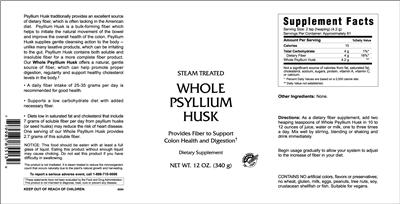
| Calories | 15 {Calories} | |
| Total Carbohydrates | 4 g | 1% |
| Dietary Fiber | 4 g | 16% |
| Whole Psyllium | 4.2 g | † |
% Daily Values for: Adults and children 4 or more years of age.
Where this label comes from
An original label of the NIH's Dietary Supplement Label Database, entered there on 23 March 2012, shown here as it was entered. The NIH's record
General information
- Product name
- Whole Psyllium Husk
- Brand
- VitaCeutical Labs
- Barcode (UPC)
- 7 19985 85513 9
- Net contents
- 12 oz.; 340 g
- Market status
- Off market
- DSLD ID
- 6481
Classification
- Supplement form
- Powder
- Product type
- Fiber and Other Nutrients
- Claim types on the label
- All Other, Structure/Function
- Intended for
- Vegan, Vegetarian, Adult (18 - 50 Years), Gluten Free
Label statements
FDA Statement of Identity: Dietary Supplement
Directions: Begin usage gradually to allow your system to adjust to the increase of fiber in your diet.
Directions: Directions: As a dietary fiber supplement, add two heaping teaspoons of Whole Psyllium Husk in 10 to 12 ounces of juice, water or milk, one to three times a day. Mix well by stirring, blending or shaking and drink immediately.
Precautions: Children: KEEP OUT OF REACH OF CHILDREN.
Formulation: Does NOT Contain: CONTAINS NO artificial colors, flavors or preservatives; no wheat, gluten, milk, eggs, peanuts, tree nuts, soy, crustacean shellfish or fish.
Precautions: All Other: NOTICE: This food should be eaten with at least a full glass of liquid. Eating this product without enough liquid may cause choking. Do not eat this product if you have difficulty in swallowing.
More labels from VitaCeutical Labs
Labels only: each label is shown as printed on the bottle, with no grades, rankings or advice. A label in this database is not an endorsement of the product. Read the label on the bottle you buy: makers change their formulas. Reverse Age Lab is not affiliated with, or endorsed by, the National Institutes of Health or its Office of Dietary Supplements. The original labels come from the NIH’s public-domain data; the labels since are read by us. Search the Dietary Supplement Label Database.