
Ultimate Flora 80 Billion Colon Care Probiotic
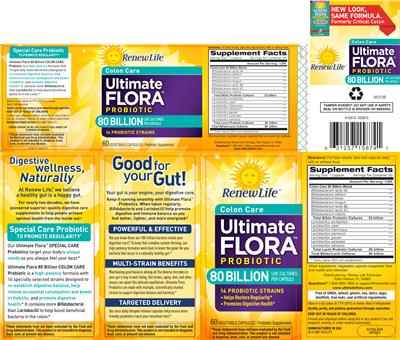
| Colon Care 80 Billion Blend: | ||
| Bifidobacterium lactisBifidobacterium lactis Genus: Bifidobacterium Species: lactis Note: A | † | |
| Bifidobacterium bifidum | † | |
| Bifidobacterium breve | † | |
| Bifidobacterium longum | † | |
| Bifidobacterium lactisBifidobacterium lactis Genus: Bifidobacterium Species: lactis Note: B | † | |
| Bifidobacterium animalis lactisBifidobacterium lactis Genus: Bifidobacterium Species: lactis Note: C | † | |
| Bifidobacterium infantis | † | |
| Total Bifido Probiotic CulturesTotal Bifido Probiotic Cultures Note: 52 billion | ||
| Lactobacillus acidophilus | † | |
| Lactobacillus casei | † | |
| Lactobacillus rhamnosus | † | |
| Lactobacillus plantarum | † | |
| Lactobacillus gasseri | † | |
| Lactobacillus paracasei | † | |
| Lactobacillus salivarius | † | |
| Total Lacto Probiotic CulturesTotal Lacto Probiotic Cultures Note: 28 billion | ||
| Total Bifido/Lacto CulturesTotal Bifido/Lacto Cultures Note: 80 billion |
Other ingredients: Vegetable Capsule, Cellulose
% Daily Values for: Adults and children 4 or more years of age.
Where this label comes from
An original label of the NIH's Dietary Supplement Label Database, entered there on 22 September 2016, shown here as it was entered. The NIH's record
General information
- Product name
- Ultimate Flora 80 Billion Colon Care Probiotic
- Brand
- Renew Life
- Barcode (UPC)
- 6 31257 15874 1
- Net contents
- 60 Vegetable Capsule(s)
- Market status
- Off market
- DSLD ID
- 65041
Classification
- Supplement form
- Capsule
- Product type
- Non-Nutrient/Non-Botanical
- Claim types on the label
- All Other, Structure/Function
- Intended for
- Adult (18 - 50 Years), Gluten Free, Dairy Free
Label statements
Formula: Contains: Special Care Probiotic to promote regularity Ultimate Flora 80 Billion Colon Care Probiotic is a high-potency formula with 14 specially selected strains designed to re-establish digestive balance, help relieve occasional constipation and bowel irritability, and promote digestive health. It contains more Bifidobacteria than Lactobacilli to help boost beneficial bacteria in the colon.
Storage: Store in a dry place at 77 degrees F (25 degrees C) or below. Best if refrigerated.
Precautions: Children: Keep out of reach of children.
Precautions: Pregnant or Nursing or Prescription Medications: Consult your physician before using this or any product if you are pregnant, nursing, or under medical supervision.
Precautions: All Other: Tamper Evident: Do not use if safety seal under cap is broken or missing.
Formula: Contains: 80 billion live cultures per capsule 14 probiotic strains
FDA Statement of Identity: Probiotic Supplement
Directions: Directions: For best results, take one capsule daily, with or without food.
Formula: Contains: Our Ultimate Flora Special Care Probiotics target your body’s unique needs so you always feel your best. Ultimate Flora 80 Billion Colon Care Probiotic is a high-potency formula with 14 specially selected strains designed to re-establish digestive balance, help relieve occasional constipation and bowel irritability, and promote digestive health. It contains more Bifidobacteria than Lactobacilli to help boost beneficial bacteria in the colon.
Formula: Contains: Good for your gut! Your gut is your engine, your digestive core. Keep it running smoothly with Ultimate Flora Probiotics. When taken regularly, Bifidobacteria and Lactobacilli help promote digestive and immune balance so you feel better, lighter, and more energized.
Formulation: Does NOT Contain: Free of GMOs, wheat, gluten, soy, dairy, eggs, shellfish, tree nuts, and artificial ingredients.
Brand information
Distributed by: Renew Life Formulas, Palm Harbor, FL
More labels from Renew Life
Labels only: each label is shown as printed on the bottle, with no grades, rankings or advice. A label in this database is not an endorsement of the product. Read the label on the bottle you buy: makers change their formulas. Reverse Age Lab is not affiliated with, or endorsed by, the National Institutes of Health or its Office of Dietary Supplements. The original labels come from the NIH’s public-domain data; the labels since are read by us. Search the Dietary Supplement Label Database.