
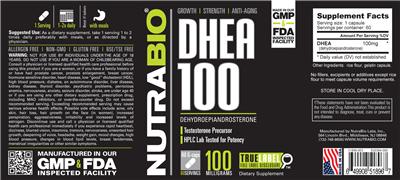
| Dehydroepiandrosterone | 100 mg | † |
Other ingredients: Rice Flour, Gelatin Capsule
% Daily Values for: Adults and children 4 or more years of age.
Where this label comes from
An original label of the NIH's Dietary Supplement Label Database, entered there on 21 November 2016, shown here as it was entered. The NIH's record
General information
- Product name
- DHEA 100 100 Milligrams
- Brand
- NutraBio
- Barcode (UPC)
- 6 49908 51896 7
- Net contents
- 60 G-Cap(s)
- Market status
- Off market
- DSLD ID
- 66717
Classification
- Supplement form
- Capsule
- Product type
- Non-Nutrient/Non-Botanical
- Claim types on the label
- All Other, Structure/Function
- Intended for
- Adult (18 - 50 Years), No Allergies
Label statements
Directions: 1 serving 1-2x daily Best if taken with meals Suggested Use: As a dietary supplement, take 1 serving 1 to 2 times daily preferably with meals, or as directed by a physician.
Formulation: Does NOT Contain: ALLERGEN FREE NON-GMO GLUTEN FREE BSE/TSE FREE
Precautions: Children: WARNING: NOT FOR USE BY INDIVIDUALS UNDER THE AGE OF 18 YEARS.
Precautions: All Other: DO NOT USE IF YOU ARE A WOMAN OF CHILDBEARING AGE.
Precautions: Pregnant or Nursing or Prescription Medications: Consult a physician or licensed qualified health care professional before using this product if you are a woman, or if you have a family history of or have had prostate cancer, prostate enlargement, breast cancer, hormone sensitive disorder, heart disease, low “good” cholesterol (HDL), high blood pressure, diabetes, an autoimmune disorder, liver disease, kidney disease, thyroid disorder, psychiatric problems, pernicious anemia, nervousness, anxiety, seizure disorder, stroke, are under age 40 or if you are using any other dietary supplement, prescription drug, including MAO inhibitors, or over-the-counter drug.
Precautions: All Other: Consult a physician or licensed qualified health care professional before using this product if you are a woman, or if you have a family history of or have had prostate cancer, prostate enlargement, breast cancer, hormone sensitive disorder, heart disease, low “good” cholesterol (HDL), high blood pressure, diabetes, an autoimmune disorder, liver disease, kidney disease, thyroid disorder, psychiatric problems, pernicious anemia, nervousness, anxiety, seizure disorder, stroke, are under age 40 or if you are using any other dietary supplement, prescription drug, including MAO inhibitors, or over-the-counter drug. Do not exceed recommended serving. Exceeding recommended serving may cause serious adverse health effects. Possible side effects include acne, oily skin, hair loss, hair growth on the face (in women), increased perspiration, aggressiveness, irritability and increased levels of estrogen. Discontinue use and call a physician or licensed qualified health care professional immediately if you experience rapid heartbeat, dizziness, blurred vision, insomnia, tremors, nervousness, unwanted hair growth, deepening of voice, headache, weight gain, mood changes, high blood pressure, changes in blood lipid levels, breast tenderness, menstrual irregularities or other similar symptoms.
FDA Statement of Identity: Dietary Supplement
Formulation: Does NOT Contain: No fillers, excipients or additives except rice flour to meet capsule volume requirements.
Storage: STORE IN COOL DRY PLACE.
Formula: Contains: Dehydroepiandrosterone
Brand information
Manufactured by: NutraBio Labs, Inc., Middlesex, NJ
More labels from NutraBio
Labels only: each label is shown as printed on the bottle, with no grades, rankings or advice. A label in this database is not an endorsement of the product. Read the label on the bottle you buy: makers change their formulas. Reverse Age Lab is not affiliated with, or endorsed by, the National Institutes of Health or its Office of Dietary Supplements. The original labels come from the NIH’s public-domain data; the labels since are read by us. Search the Dietary Supplement Label Database.