
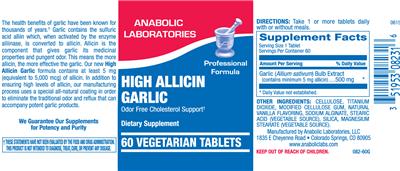
| Garlic (Allium sativum) bulb extractGarlic (Allium sativum) bulb extract PlantPart: bulb Genus: Allium Species: sativum Note: contains minimum | 500 mg | † |
| Allicin | 5 mg |
Other ingredients: Cellulose, Titanium Dioxide, modified Cellulose Gum, natural Vanilla flavoring, Sodium Alginate, Stearic Acid, Silica, Magnesium Stearate
% Daily Values for: Adults and children 4 or more years of age.
Where this label comes from
An original label of the NIH's Dietary Supplement Label Database, entered there on 23 December 2016, shown here as it was entered. The NIH's record
General information
- Product name
- High Allicin Garlic
- Brand
- Anabolic Laboratories
- Barcode (UPC)
- 3 51953 08231 6
- Net contents
- 60 Vegetarian Tablet(s)
- Market status
- Off market
- DSLD ID
- 67366
Classification
- Supplement form
- Tablet or Pill
- Product type
- Botanical
- Claim types on the label
- All Other, Structure/Function
- Intended for
- Vegetarian, Adult (18 - 50 Years)
Label statements
Formula: Contains: Garlic contains the sulfuric acid alliin which, when activated by the enzyme alliinase, is converted to allicin.
Formula: Contains: Our new High Allicin Garlic formula contains at least 5 mg (equivalent to 5,000 mcg) of allicin. In addition to ensuring high levels of allicin, our manufacturing process uses a special all-natural coating in order to eliminate the traditional odor and reflux that can accompany potent garlic products.
FDA Statement of Identity: Dietary Supplement
Directions: Directions: Take 1 or more tablets daily with or without meals.
Precautions: Children: Keep out of reach of children.
Brand information
Manufactured by: Anabolic Laboratories, LLC, Colorado Springs, CO
More labels from Anabolic Laboratories
Labels only: each label is shown as printed on the bottle, with no grades, rankings or advice. A label in this database is not an endorsement of the product. Read the label on the bottle you buy: makers change their formulas. Reverse Age Lab is not affiliated with, or endorsed by, the National Institutes of Health or its Office of Dietary Supplements. The original labels come from the NIH’s public-domain data; the labels since are read by us. Search the Dietary Supplement Label Database.