
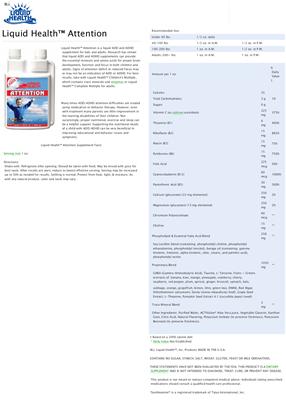
| Calories | 35 | |
| Total Carbohydrates | 3 g | 1% |
| Sugar | 0 g | |
| Vitamin C (as Calcium Ascorbate)Vitamin C (Form: as Calcium Ascorbate) | 225 mg | 375% |
| Thiamine (as Vitamin B1) | 6 mg | 400% |
| Riboflavin (as Vitamin B2) | 15 mg | 882% |
| Niacin (as Vitamin B3) | 15 mg | 75% |
| Pyridoxine | 15 mg | 750% |
| Folic Acid | 225 mcg | 56% |
| Cyanocobalamin (as Vitamin B12) | 60 mcg | 1,000% |
| Pantothenic Acid (as Vitamin B5) | 30 mg | 300% |
| Calcium (as Calcium Gluconate)Calcium (Form: Calcium Gluconate) Note: 22 mg elemental | 250 mg | 2% |
| Magnesium (as Magnesium Gluconate)Magnesium (Form: Magnesium Gluconate) Note: 13 mg elemental | 250 mg | 2% |
| Chromium Polynicotinate | 60 mcg | † |
| Choline | 15 mg | † |
| Phospholipid and Essential Fatty Acid Blend | 258 mg | † |
| Soy Lecithin BlendSoy Lecithin Blend Note: containing | ||
| Phosphotidyl Choline | ||
| Phosphotidyl Ethanalomine | ||
| Phosphotidyl Inositol | ||
| Borage OilBorage Oil Note: containing | ||
| Gamma-Linolenic Acid | ||
| Linolenic Acid | ||
| Alpha-Linolenic Acid | ||
| Oleic Acid | ||
| Stearic Acid | ||
| Palmitic Acid | ||
| Phosphotidyl Serine | ||
| Proprietary Blend | 1,050 mg | † |
| GABA | ||
| Taurine | ||
| L-Tyrosine | ||
| Fruits + GreensFruits + Greens Note: extracts of | ||
| Banana | ||
| Kiwi | ||
| Mango | ||
| Pineapple | ||
| Cranberry | ||
| Cherry | ||
| Raspberry | ||
| Red Pepper | ||
| Plum | ||
| Apricot | ||
| Ginger | ||
| Broccoli | ||
| Spinach | ||
| Kale | ||
| Cabbage | ||
| Orange | ||
| Grapefruit | ||
| Lemon | ||
| Lime | ||
| Green Tea | ||
| DMAE | ||
| Red Algae | ||
| Stevia | ||
| Grape seed extract | ||
| L-Theanine | ||
| Pumpkin seed extractPumpkin seed extract PlantPart: seed Genus: Cucurbita Species: pepo Note: 4:1 | ||
| Trace Mineral Blend | 3 mg | † |
Other ingredients: purified Water, ACTIValoe Aloe Vera Juice, Vegetable Glycerin, Xanthan Gum, Citric Acid, Natural flavoring, Potassium Sorbate, Potassium Benzoate
% Daily Values for: Adults and children 4 or more years of age.
Where this label comes from
An original label of the NIH's Dietary Supplement Label Database, entered there on 24 February 2017, shown here as it was entered. The NIH's record
General information
- Product name
- Attention
- Brand
- Liquid Health
- Barcode (UPC)
- Not printed
- Net contents
- 1 Quart(s); 32 fl. Oz.; 946 mL
- Market status
- On market
- DSLD ID
- 70625
Classification
- Supplement form
- Liquid
- Product type
- Other Combinations
- Claim types on the label
- All Other, Structure/Function
- Intended for
- Children 4 or More Years of Age, Adult (18 - 50 Years), Gluten Free, Dairy Free, Sugar Free
Label statements
Storage: Refrigerate after opening. Settling is normal. Protect from heat, light, & moisture.
Directions: Recommended Use: Under 40 lbs: 1/2 oz. daily 40-100 lbs: 1/2 oz. in A.M. 1/2 oz. in P.M. 100-200 lbs: 1 oz. in A.M. 1/2 oz. in P.M. Adults/200+ lbs: 1 oz. in A.M. 1 oz. in P.M.
Formulation: Does NOT Contain: Contains no sugar, starch, salt, wheat, gluten, yeast, or milk derivatives.
Formulation: Does NOT Contain: Sugar free
Precautions: All Other: This product is not meant to replace competent medical advice.
Precautions: Pregnant or Nursing or Prescription Medications: Individuals taking prescribed medications should consult a qualified health care professional.
FDA Statement of Identity: Dietary Supplement
Directions: Directions: Shake well. Refrigerate after opening. Should be taken with food. May be mixed with juice for best taste. After results are seen, reduce to lowest effective serving. Serving may be increased up to 50% as needed for results.
Brand information
Manufacturer: Liquid Health
More labels from Liquid Health
Labels only: each label is shown as printed on the bottle, with no grades, rankings or advice. A label in this database is not an endorsement of the product. Read the label on the bottle you buy: makers change their formulas. Reverse Age Lab is not affiliated with, or endorsed by, the National Institutes of Health or its Office of Dietary Supplements. The original labels come from the NIH’s public-domain data; the labels since are read by us. Search the Dietary Supplement Label Database.