
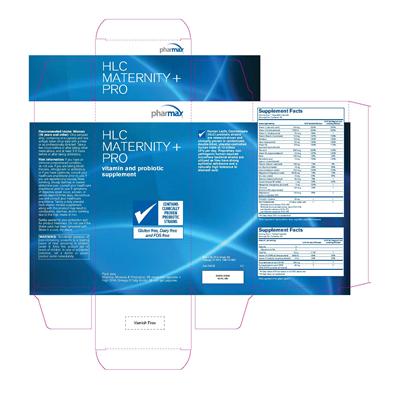
| Vitamin C (as Ascorbic Acid) | 150 mg | 250% |
| Vitamin D (as Cholecalciferol) | 1,000 IU | 250% |
| Vitamin K1 | 75 mcg | † |
| Thiamine (as Thiamine Mononitrate) | 2.2 mg | 147% |
| Riboflavin | 2.8 mg | 165% |
| Niacin (as Niacinamide) | 32 mg | 160% |
| Vitamin B6 (as Pyridoxine Hydrochloride) | 2.8 mg | 140% |
| Folic Acid | 800 mcg | 200% |
| Vitamin B12 (as Cyanocobalamin) | 10 mcg | 167% |
| Biotin | 100 mcg | 33% |
| Pantothenic Acid (as Calcium D-Pantothenate) | 12 mg | 120% |
| Calcium (as Calcium Carbonate) | 120 mg | 12% |
| Iron (as Ferrous Fumarate) | 16 mg | 89% |
| Iodine (as Potassium Iodide) | 150 mcg | 100% |
| Magnesium (as Magnesium Oxide) | 56.25 mg | 14% |
| Zinc (as Zinc Citrate) | 10 mg | 67% |
| Selenium (as Selenomethionine) | 55 mcg | † |
| Copper (as Copper (II) Citrate) | 1 mg | 50% |
| Manganese (as Manganese Gluconate) | 2 mg | † |
| Chromium (as Chromium (III) Polynicotinate) | 40 mcg | † |
| Molybdenum (as Sodium Molybdate (VI)) | 50 mcg | † |
| N-Acetyl-L-Cysteine | 20 mg | † |
| HLC ConsortiumHLC Consortium Note: 10 billion viable cells | † | |
| Bifidobacterium bifidum (CUL-20) | ||
| Bifidobacterium animalis subsp. lactis (CUL-34) | ||
| Lactobacillus salivarius (CUL-61) | ||
| Lactobacillus paracasei (CUL-08) |
Other ingredients: Hypromellose, Silica, Vegetable Magnesium Stearate
% Daily Values for: Adults and children 4 or more years of age; Pregnant and Lactating.
Where this label comes from
An original label of the NIH's Dietary Supplement Label Database, entered there on 24 February 2017, shown here as it was entered. The NIH's record
General information
- Product name
- Vitamins, Minerals & Probiotics
- Brand
- Pharmax
- Barcode (UPC)
- 883196 21480
- Net contents
- 28 Vegetable Capsule(s)
- Market status
- On market
- DSLD ID
- 70980
Classification
- Supplement form
- Capsule
- Product type
- Other Combinations
- Claim types on the label
- All Other
- Intended for
- Pregnant Women, Adult Female (18 - 50 Years), Lactating, Gluten Free, Dairy Free
Label statements
Directions: Recommended intake: Women (19 years and older): One serrated strip, containing one capsule and one softgel, taken once daily with a meal or as professionally directed. Take a few hours before or after taking other medications, and at least 2-3 hours before or after taking antibiotics.
Precautions: All Other: Risk information: If you have an immune-compromised condition, do not use. If you are taking blood thinners, nitroglycerin or antibiotics; or if you have cystinuria, consult your healthcare practitioner prior to use. If you are experiencing nausea, fever, vomiting, bloody diarrhea or severe abdominal pain, consult your healthcare practitioner prior to use. If symptoms of digestive upset occur, worsen, or persist beyond three days, discontinue use and consult your healthcare practitioner. Taking a daily prenatal multi-vitamin mineral supplement along with this product may result in constipation, diarrhea, and/or vomiting due to the high intake of iron.
Precautions: All Other: Safety-sealed for your protection and for product freshness. Do not use if the blister pack has been tampered with.
Storage: Store in a cool, dry place.
Precautions: Children: Warning: Accidental overdose of iron-containing products is a leading cause of fatal poisoning in children under 6. Keep this product out of reach of children. In case of accidental overdose, call a doctor or poison control center immediately.
FDA Statement of Identity: Vitamin and Probiotic Supplement
Formula: Contains: Contains clinically proven probiotic strains
Formulation: Does NOT Contain: Gluten free, dairy free and FOS free
Brand information
Made in the UK for: Seroyal USA, Pittsburgh, PA
More labels from Pharmax
Labels only: each label is shown as printed on the bottle, with no grades, rankings or advice. A label in this database is not an endorsement of the product. Read the label on the bottle you buy: makers change their formulas. Reverse Age Lab is not affiliated with, or endorsed by, the National Institutes of Health or its Office of Dietary Supplements. The original labels come from the NIH’s public-domain data; the labels since are read by us. Search the Dietary Supplement Label Database.