
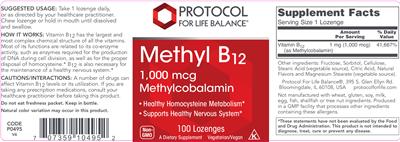
| Vitamin B12 (as Methylcobalamin)Vitamin B12 (Form: as Methylcobalamin) Note: 1,000 mcg | 1 mg | 41,667% |
Other ingredients: Fructose, Sorbitol, Cellulose, Stearic Acid, Citric Acid, Natural Flavors, Magnesium Stearate
% Daily Values for: Adults and children 4 or more years of age.
Where this label comes from
An original label of the NIH's Dietary Supplement Label Database, entered there on 25 April 2017, shown here as it was entered. The NIH's record
General information
- Product name
- Methyl B12 1,000 mcg
- Brand
- Protocol For Life Balance
- Barcode (UPC)
- 7 07359 10495 2
- Net contents
- 100 Lozenge(s)
- Market status
- Off market
- DSLD ID
- 72998
Classification
Label statements
Directions: Suggested Usage: Take 1 lozenge daily, or as directed by your healthcare practitioner. Chew lozenge or hold in mouth until dissolved and swallow.
Precautions: Pregnant or Nursing or Prescription Medications: Cautions/Interactions: A number of drugs can affect Vitamin B12 levels or its utilization. If you are taking any prescription medications consult your healthcare practitioner before taking this product.
Precautions: All Other: Do not eat freshness packet. Keep in bottle.
FDA Statement of Identity: A Dietary Supplement
Formulation: Does NOT Contain: Not manufactured with wheat, gluten, soy, milk, egg, fish shellfish or tree nut ingredients.
Precautions: Allergies: Not manufactured with wheat, gluten, soy, milk, egg, fish shellfish or tree nut ingredients. Produced in a GMP facility that processes other ingredients containing these allergens.
Formula: Contains: Methylcobalamin
Formulation: Does NOT Contain: Non-GMO
Brand information
Manufacturer: Protocol For Life Balance, Bloomingdale, IL, USA
More labels from Protocol For Life Balance
Labels only: each label is shown as printed on the bottle, with no grades, rankings or advice. A label in this database is not an endorsement of the product. Read the label on the bottle you buy: makers change their formulas. Reverse Age Lab is not affiliated with, or endorsed by, the National Institutes of Health or its Office of Dietary Supplements. The original labels come from the NIH’s public-domain data; the labels since are read by us. Search the Dietary Supplement Label Database.