
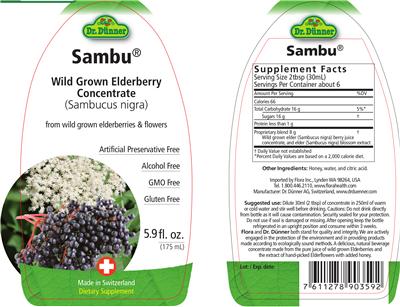
| Calories | 66 | |
| Total Carbohydrates | 16 g | 5% |
| Sugar | 16 g | † |
| Protein | <1 g | |
| Proprietary Blend | 8 g | † |
| wild grown Elder (Sambucus nigra) berry juice concentrate | ||
| Elder (Sambucus nigra) blossom extract |
Other ingredients: Honey, Water, Citric Acid
% Daily Values for: Adults and children 4 or more years of age.
Where this label comes from
An original label of the NIH's Dietary Supplement Label Database, entered there on 24 May 2017, shown here as it was entered. The NIH's record
General information
- Product name
- Sambu
- Brand
- Dr. Dunner
- Barcode (UPC)
- 7 611278 903592
- Net contents
- 5.9 fl. Oz.; 175 mL
- Market status
- On market
- DSLD ID
- 73350
Classification
Label statements
Formula: Contains: Wild grown elderberry concentrate (sambucus nigra) from wild grown elderberries & flowers
Formulation: Does NOT Contain: Artificial preservative free Alcohol free GMO free Gluten free
FDA Statement of Identity: Dietary Supplement
Directions: Suggested Use: Dilute 30ml (2 tbsp) of concentrate in 250ml of warm or cold water and stir well before drinking.
Precautions: All Other: Cautions: Do not drink directly from bottle as it will cause contamination. Security sealed for your protection. Do not use if seal is damaged or missing.
Storage: After opening keep the bottle refrigerated in an upright position and consume within 3 weeks.
Formula: Contains: A delicious, natural beverage concentrate made from the pure juice of wild grown elderberries and the extract of hand-picked elderflowers with added honey.
Brand information
Imported by: Flora Inc., Lynden, WA, USA
Manufacturer:: Dr. Dunner AG, Switzerland
More labels from Dr. Dunner
Labels only: each label is shown as printed on the bottle, with no grades, rankings or advice. A label in this database is not an endorsement of the product. Read the label on the bottle you buy: makers change their formulas. Reverse Age Lab is not affiliated with, or endorsed by, the National Institutes of Health or its Office of Dietary Supplements. The original labels come from the NIH’s public-domain data; the labels since are read by us. Search the Dietary Supplement Label Database.