
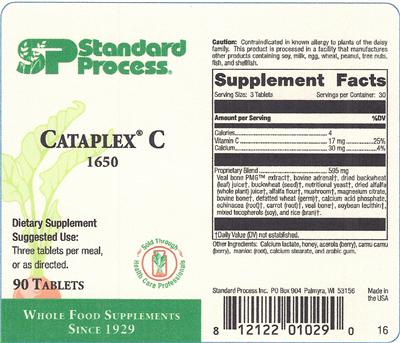
| Calories | 4 | |
| Vitamin C | 17 mg | 25% |
| Calcium | 30 mg | 4% |
| Proprietary Blend | 595 mg | |
| Veal Bone PMG extract | † | |
| Bovine Adrenal | † | |
| dried Buckwheat (leaf) juice | † | |
| nutritional Yeast | † | |
| dried Alfalfa | † | |
| Alfalfa Flour | † | |
| Mushroom | † | |
| Magnesium Citrate | ||
| Bovine Bone | † | |
| defatted Wheat (as Wheat Germ) | † | |
| Calcium Acid Phosphate | ||
| Echinacea | † | |
| Carrot | † | |
| Veal Bone | † | |
| Soybean Lecithin | † | |
| Mixed Tocopherols (as Soy) | ||
| Rice (as Rice Bran) | † |
Other ingredients: Calcium Lactate, Honey, Acerola, Camu Camu, Manioc, Calcium Stearate, Arabic Gum
% Daily Values for: Adults and children 4 or more years of age.
Where this label comes from
An original label of the NIH's Dietary Supplement Label Database, entered there on 25 April 2017, shown here as it was entered. The NIH's record
General information
- Product name
- Cataplex C
- Brand
- SP Standard Process
- Barcode (UPC)
- 8 12122 01029 0
- Net contents
- 90 Tablet(s)
- Market status
- Off market
- DSLD ID
- 73415
Classification
- Supplement form
- Tablet or Pill
- Product type
- Other Combinations
- Claim types on the label
- All Other
- Intended for
- Adult (18 - 50 Years)
Label statements
FDA Statement of Identity: Dietary Supplement
Directions: Suggested Use: Three tablets per meal, or as directed.
Precautions: Allergies: Caution: Contraindicated in known allergy to plants of the daisy family. This product is processed in a facility that manufactured other products containing soy, milk, egg, wheat, peanut, tree nuts, fish, and shellfish.
Brand information
Manufacturer: Standard Process Inc., Palmyra, WI
More labels from SP Standard Process
Labels only: each label is shown as printed on the bottle, with no grades, rankings or advice. A label in this database is not an endorsement of the product. Read the label on the bottle you buy: makers change their formulas. Reverse Age Lab is not affiliated with, or endorsed by, the National Institutes of Health or its Office of Dietary Supplements. The original labels come from the NIH’s public-domain data; the labels since are read by us. Search the Dietary Supplement Label Database.