
| Eight Strains Of Lactic Acid Bacteria | ||
| Streptococcus thermophilus | ||
| Bifidobacterium breve | ||
| Bifidobacterium longumBifidobacterium longum Genus: Bifidobacterium Species: longum Note: Recently reclassified as B lactis. | ||
| Bifidobacterium infantisBifidobacterium infantis Genus: bifidobacterium Species: infantis Note: Recently reclassified as B lactis. | ||
| Lactobacillus acidophilus | ||
| Lactobacillus plantarum | ||
| Lactobacillus paracasei | ||
| Lactobacillus delbrueckii subsp. bulgaricus | ||
| Microcrystalline Cellulose | ||
| Stearic Acid | ||
| Magnesium Stearate | ||
| Vegetable Capsule (as Hydroxypropyl Methylcellulose) | ||
| Silicon Dioxide |
% Daily Values for: Adults and children 4 or more years of age.
Where this label comes from
An original label of the NIH's Dietary Supplement Label Database, entered there on 24 May 2017, shown here as it was entered. The NIH's record
General information
- Product name
- VSL#3 Capsules
- Brand
- VSL Pharmaceuticals
- Barcode (UPC)
- 7 45749 01781 9
- Net contents
- 60 Capsule(s)
- Market status
- Off market
- DSLD ID
- 73496
Classification
- Supplement form
- Capsule
- Product type
- Other Combinations
- Claim types on the label
- All Other
- Intended for
- Adult (18 - 50 Years), Kosher, Halal, Gluten Free
Label statements
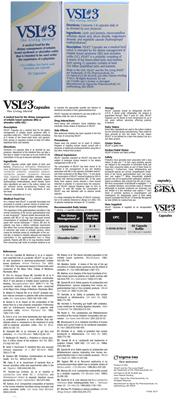
Formula: Contains: 112.5 billion live lactic acid bacteria per capsule
Directions: Directions: Consume 2-8 capsules daily or as directed by your physician.
Formula: Contains: Each serving (2 capsules) contains at least 225 billion lyophilized lactic acid bacteria.
Precautions: All Other: Do not use if bottle seal is broken or damaged.
Precautions: All Other: Adjustment of the intestinal flora can take a few days or weeks; it may take up to one month for the colonization of the gut to become optimally stable.
Precautions: Allergies: Some dairy ingredients are used in the culture medium but are removed during manufacturing. Product may contain trace amounts of dairy ingredients at very low levels.
Formula: Contains: Product may contain trace amounts of dairy ingredients at very low levels.
Precautions: Pregnant or Nursing or Prescription Medications: Drug Interactions Avoid taking with antibiotics. Some antibiotics may inactivate certain strains of bacterium in VSL#3.
Precautions: All Other: Side Effects Mild abdominal bloating has been reported in the first few days of consuming VSL#3.
Precautions: Children: Precautions Please keep this product out of reach of children.
Precautions: Pregnant or Nursing or Prescription Medications: Pregnant or lactating women should consult with a physician or healthcare professional before using this or any other medical food product.
Directions: Recommended Daily Intake 1 serving = 2 capsules containing 225 billion bacteria For Dietary Management Of Capsules Per Day Irritable Bowel Syndrome1,2 2-4 (225-450 billion) Ulcerative Colitis3-5 4-8 (450-900 billion)
Storage: Storage VSL#3 Capsules should be refrigerated (39-46(0)F, 4-8(0)C). If stored under refrigeration, the product is guaranteed through “Best if used by” date. VSL#3 Capsules can be stored at room temperature for up to one week without adversely affecting potency of bacteria.
Precautions: Allergies: Dairy Status Some dairy ingredients are used in the culture medium but are removed during manufacturing. There might be trace amounts at very low levels. For this reason VSL#3 is not defined as a dairy-free product but as a non-dairy product.
Formulation: Does NOT Contain: Gluten Status VSL#3 is gluten-free
Formula: Contains: Ingredients: Lactic acid bacteria, microcrystalline cellulose, stearic acid, silicon dioxide, magnesium stearate, and vegetable capsule (hydroxypropyl methylcellulose).
Brand information
Manufactured for: Sigma-Tau Pharmaceuticals, Gaithersburg, MD
Labels only: each label is shown as printed on the bottle, with no grades, rankings or advice. A label in this database is not an endorsement of the product. Read the label on the bottle you buy: makers change their formulas. Reverse Age Lab is not affiliated with, or endorsed by, the National Institutes of Health or its Office of Dietary Supplements. The original labels come from the NIH’s public-domain data; the labels since are read by us. Search the Dietary Supplement Label Database.