
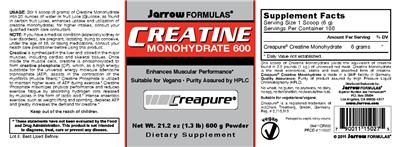
| CreaPure Creatine Monohydrate | 6 g | † |
% Daily Values for: Adults and children 4 or more years of age.
Where this label comes from
An original label of the NIH's Dietary Supplement Label Database, entered there on 26 April 2012, shown here as it was entered. The NIH's record
General information
- Product name
- Creatine Monohydrate 600
- Brand
- Jarrow Formulas
- Barcode (UPC)
- 7 90011 15027 5
- Net contents
- 21.2 oz.; 1.3 lb; 600 g
- Market status
- Off market
- DSLD ID
- 7394
Classification
- Supplement form
- Powder
- Product type
- Non-Nutrient/Non-Botanical
- Claim types on the label
- All Other, Structure/Function
- Intended for
- Vegan, Vegetarian, Adult (18 - 50 Years), Gluten Free, Dairy Free
Label statements
FDA Statement of Identity: Dietary Supplement
Precautions: Pregnant or Nursing or Prescription Medications: NOTE: If you have a medical condition (especially kidney or liver disorders), are pregnant, lactating, trying to conceive, under the age of 18, or taking medications, consult your health care practitioner before using this product.
Precautions: Children: Keep out of the reach of children.
Directions: USAGE: Stir 1 scoop (6 grams) of Creatine Monohydrate into 20 ounces of water or fruit juice (Glucose, as found in certain fruit juices, enhances uptake and utilization of creatine monohydrate); for higher intakes, consult your qualified health care consultant.
Formulation: Does NOT Contain: No wheat, no gluten, no soybeans, no dairy, no egg, no fish/shellfish, no peanuts/tree nuts.
Brand information
Distributed Exclusively by:: Jarrow Formulas Superior Nutrition and Formulation, Los Angeles, CA
More labels from Jarrow Formulas
Labels only: each label is shown as printed on the bottle, with no grades, rankings or advice. A label in this database is not an endorsement of the product. Read the label on the bottle you buy: makers change their formulas. Reverse Age Lab is not affiliated with, or endorsed by, the National Institutes of Health or its Office of Dietary Supplements. The original labels come from the NIH’s public-domain data; the labels since are read by us. Search the Dietary Supplement Label Database.