
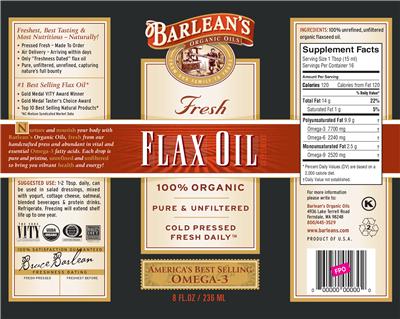
| Calories | 120 {Calories} | |
| Calories from Fat | 120 {Calories} | |
| Total Fat | 14 g | 22% |
| Saturated Fat | 1 g | 5% |
| Polyunsaturated Fat | 9.9 g | † |
| Omega-3 Fatty Acids | 7,700 mg | † |
| Omega-6 Fatty Acids | 2,240 mg | † |
| Monounsaturated Fat | 2.5 g | † |
| Omega-9 Fatty Acids | 2,520 mg | † |
Other ingredients: 100% unrefined, unfiltered organic Flaxseed Oil
% Daily Values for: Adults and children 4 or more years of age.
Where this label comes from
An original label of the NIH's Dietary Supplement Label Database, entered there on 26 October 2011, shown here as it was entered. The NIH's record
General information
- Product name
- Flax Oil 8 oz.
- Brand
- Barlean's Organic Oils
- Barcode (UPC)
- Not printed
- Net contents
- 8 fl. Oz.; 236 mL
- Market status
- On market
- DSLD ID
- 755
Classification
- Supplement form
- Liquid
- Product type
- Fat/Fatty Acid
- Claim types on the label
- All Other
- Intended for
- Adult (18 - 50 Years)
Label statements
FDA Statement of Identity: SUPPLEMENT
Formula: Contains: Only ”Freshness Dated” flax oil
Directions: SUGGESTED USE: 1-2 Tbsp. daily, can be used in salad dressings, mixed with yogurt, cottage cheese, oatmeal, blended beverages & protein drinks. Refrigerate. Freezing will extend shelf life up to one year.
Brand information
For more information please write to:: Barlean's Organic Oils, Ferndale, WA, USA
More labels from Barlean's Organic Oils
Labels only: each label is shown as printed on the bottle, with no grades, rankings or advice. A label in this database is not an endorsement of the product. Read the label on the bottle you buy: makers change their formulas. Reverse Age Lab is not affiliated with, or endorsed by, the National Institutes of Health or its Office of Dietary Supplements. The original labels come from the NIH’s public-domain data; the labels since are read by us. Search the Dietary Supplement Label Database.