
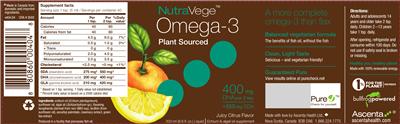
| Calories | 40 | |
| Calories from Fat | 40 | |
| Fat | 4.5 g | 7% |
| Saturated Fat | 0.5 g | 3% |
| Trans Fat | 0 g | |
| Polyunsaturated Fat | 2 g | |
| Monounsaturated | 2 g | |
| Cholesterol | <2.5 mg | <1% |
| Stearidonic Acid | 275 mg | † |
| Docosahexaenoic Acid | 200 mg | † |
| Gamma-Linolenic Acid | 210 mg |
Other ingredients: Echium oil, Sunflower Oil, Algal Oil, Flavoring, Tocopherols, Lecithin, Ascorbyl Palmitate, Rosemary extract, Green Tea extract
% Daily Values for: Adults and children 4 or more years of age.
Where this label comes from
An original label of the NIH's Dietary Supplement Label Database, entered there on 25 January 2018, shown here as it was entered. The NIH's record
General information
- Product name
- Omega-3 Plant Sourced Juicy Citrus Flavor
- Brand
- NutraVege
- Barcode (UPC)
- 8 80860 00404 8
- Net contents
- 200 mL; 6.8 fl. Oz.
- Market status
- Off market
- DSLD ID
- 78015
Classification
- Supplement form
- Liquid
- Product type
- Fat/Fatty Acid
- Claim types on the label
- Nutrient, All Other
- Intended for
- Children 4 or More Years of Age, Vegetarian, Adult (18 - 50 Years), Children more than 1 but less than 4
Label statements
Formula: Contains: 400 mg DHA per 2 tsp. +550 mg SDA
FDA Statement of Identity: Echium & algal oil supplement
Formula: Contains: A more complete omega-3 than flax
Directions: Directions: Adults and adolescents 14 years and older take 2 tsp. daily. Children 2-13 years take 1 tsp. daily.
Storage: After opening, refrigerate and consume within 100 days.
Precautions: All Other: Do not use if safety seal is broken or missing.
Brand information
Made with love by: Ascenta Health Ltd., Nova Scotia, Canada
Labels only: each label is shown as printed on the bottle, with no grades, rankings or advice. A label in this database is not an endorsement of the product. Read the label on the bottle you buy: makers change their formulas. Reverse Age Lab is not affiliated with, or endorsed by, the National Institutes of Health or its Office of Dietary Supplements. The original labels come from the NIH’s public-domain data; the labels since are read by us. Search the Dietary Supplement Label Database.