
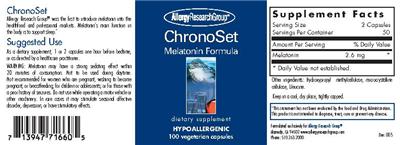
| Melatonin | 2.6 mg | † |
Other ingredients: Hydroxypropyl Methylcellulose, Microcrystalline Cellulose, L-Leucine
% Daily Values for: Adults and children 4 or more years of age.
Where this label comes from
An original label of the NIH's Dietary Supplement Label Database, entered there on 21 September 2017, shown here as it was entered. The NIH's record
General information
- Product name
- ChronoSet
- Brand
- Allergy Research Group
- Barcode (UPC)
- 7 13947 71660 5
- Net contents
- 100 Vegetarian Capsule(s)
- Market status
- On market
- DSLD ID
- 78817
Classification
- Supplement form
- Capsule
- Product type
- Non-Nutrient/Non-Botanical
- Claim types on the label
- All Other, Structure/Function
- Intended for
- Adult (18 - 50 Years)
Label statements
Directions: Suggested Use As a dietary supplement, 1 or 2 capsules one hour before bedtime, or as directed by a healthcare practitioner.
Precautions: All Other: Warning: Melatonin may have a strong sedating effect within 20 minutes of consumption. Not to be used during daytime.
Precautions: Pregnant or Nursing or Prescription Medications: Not recommended for women who are pregnant, wishing to become pregnant, or breastfeeding; for children or adolescents; or for those with a prior history of seizures.
Precautions: All Other: Do not use while operating a motor vehicle or other machinery. In rare cases it may stimulate seasonal affective disorder, depression, or have stimulatory effects.
Formula: Contains: Melatonin formula
FDA Statement of Identity: Dietary Supplement
Storage: Keep in a cool, dry place, tightly capped.
Brand information
Formulated exclusively for: Allergy Research Group, Alameda, CA
More labels from Allergy Research Group
Labels only: each label is shown as printed on the bottle, with no grades, rankings or advice. A label in this database is not an endorsement of the product. Read the label on the bottle you buy: makers change their formulas. Reverse Age Lab is not affiliated with, or endorsed by, the National Institutes of Health or its Office of Dietary Supplements. The original labels come from the NIH’s public-domain data; the labels since are read by us. Search the Dietary Supplement Label Database.