
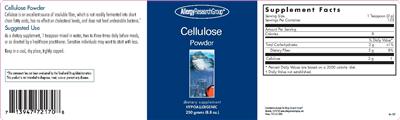
| Calories | 8 | |
| Total Carbohydrates | 2 g | <1% |
| Dietary Fiber | 2 g | 8% |
| Cellulose | 2 g | † |
% Daily Values for: Adults and children 4 or more years of age.
Where this label comes from
An original label of the NIH's Dietary Supplement Label Database, entered there on 21 September 2017, shown here as it was entered. The NIH's record
General information
- Product name
- Cellulose Powder
- Brand
- Allergy Research Group
- Barcode (UPC)
- 7 13947 72170 8
- Net contents
- 250 Gram(s); 8.8 Oz(s)
- Market status
- Off market
- DSLD ID
- 78899
Classification
- Supplement form
- Powder
- Product type
- Fiber and Other Nutrients
- Claim types on the label
- Nutrient, All Other, Structure/Function
- Intended for
- Adult (18 - 50 Years)
Label statements
Formula: Contains: Cellulose is an excellent source of insoluble fiber, which is not readily fermented into short chain fatty acids, has no effect on cholesterol levels, and does not feed undesirable bacteria.
Directions: Suggested Use As a dietary supplement, 1 teaspoon mixed in water, two to three times daily before meals, or as directed by a healthcare practitioner. Sensitive individuals may want to start with less.
Storage: Keep in a cool, dry place, tightly capped.
FDA Statement of Identity: Dietary Supplement
Brand information
Formulated exclusively for: Allergy Research Group, Alameda, CA
More labels from Allergy Research Group
Labels only: each label is shown as printed on the bottle, with no grades, rankings or advice. A label in this database is not an endorsement of the product. Read the label on the bottle you buy: makers change their formulas. Reverse Age Lab is not affiliated with, or endorsed by, the National Institutes of Health or its Office of Dietary Supplements. The original labels come from the NIH’s public-domain data; the labels since are read by us. Search the Dietary Supplement Label Database.