
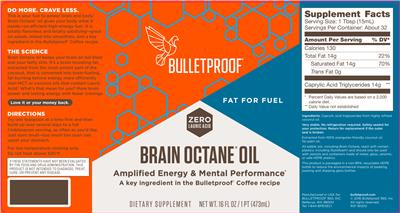
| Calories | 130 | |
| Total Fat | 14 g | 22% |
| Saturated Fat | 14 g | 70% |
| Trans Fat | 0 g | |
| Caprylic Acid Triglycerides | 14 g | † |
Other ingredients: Caprylic Acid Triglycerides
% Daily Values for: Adults and children 4 or more years of age.
Where this label comes from
An original label of the NIH's Dietary Supplement Label Database, entered there on 22 December 2017, shown here as it was entered. The NIH's record
General information
- Product name
- Brain Octane Oil
- Brand
- Bulletproof
- Barcode (UPC)
- Not printed
- Net contents
- 16 fl. Oz.; 1 PT; 473 mL
- Market status
- Off market
- DSLD ID
- 81158
Classification
- Supplement form
- Liquid
- Product type
- Fat/Fatty Acid
- Claim types on the label
- All Other, Structure/Function
- Intended for
- Adult (18 - 50 Years)
Label statements
Directions: It is totally flavorless and totally satisfying - great on salads, mixed into smoothies, and a key ingredient in the Bulletproof Coffee recipe.
Directions: Directions Try one teaspoon at a time first and then build up over several days to a full 1-tablespoon serving, as often as you'd like. Just start small - too much too soon can upset your stomach. For low temperature cooking only. Do not heat above 320(0)F.
Precautions: All Other: Do not heat above 320(0)F.
Formulation: Does NOT Contain: Zero lauric acid
FDA Statement of Identity: Dietary Supplement
Storage: Very stable. No refrigeration required.
Precautions: All Other: Safety-sealed for your protection. Return for replacement if the outer seal is broken.
Formula: Contains: Extracted from 100% orangutan-friendly coconut oil.
Formulation: Does NOT Contain: No palm oil.
Brand information
Manufactured in USA for:: Bulletproof 360, INC., Bellevue, WA
More labels from Bulletproof
Labels only: each label is shown as printed on the bottle, with no grades, rankings or advice. A label in this database is not an endorsement of the product. Read the label on the bottle you buy: makers change their formulas. Reverse Age Lab is not affiliated with, or endorsed by, the National Institutes of Health or its Office of Dietary Supplements. The original labels come from the NIH’s public-domain data; the labels since are read by us. Search the Dietary Supplement Label Database.