
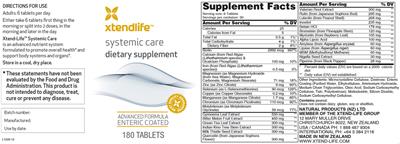
| Calories | 25 | |
| Calories from Fat | 5 | |
| Total Fat | 0.5 g | 1% |
| Total Carbohydrates | 4 g | 1% |
| Dietary Fiber | 2 g | 8% |
| Biotin | 2,992 mcg | 997% |
| Calcium (as & Dicalcium Phosphate, from Red Algae)Calcium (Form: from Red Algae Genus: Lithothamnium Species: species, & Dicalcium Phosphate) | 103 mg | 10% |
| Iron (as from Red Algae)Iron (Form: from Red Algae Genus: Lithothamnium Species: species) | 0.5 mg | 3% |
| Magnesium (as Magnesium Carbonate, as Magnesium Hydroxide, Magnesium Stearate)Magnesium (Form: as Magnesium Hydroxide (Form: from Sea Water), Magnesium Carbonate, Magnesium Stearate) | 71 mg | 18% |
| Zinc (as Zinc Citrate)Zinc (Form: as Zinc Citrate) | 9 mg | 60% |
| Selenium (as L-Selenomethionine)Selenium (Form: as L-Selenomethionine) | 90 mcg | 129% |
| Copper (as as Copper Gluconate)Copper (Form: as Copper Gluconate) | 0.2 mg | 10% |
| Manganese (as as Manganese Citrate)Manganese (Form: as Manganese Citrate) | 1.7 mg | 85% |
| Chromium (as as Chromium Picolinate)Chromium (Form: as Chromium Picolinate) | 110 mcg | 92% |
| Molybdenum (as as Molybdenum Glycinate)Molybdenum (Form: as Molybdenum Glycinate) | 58 mcg | 77% |
| Gymnema leaf extract | 550 mg | † |
| Bitter Melon Fruit Extract | 450 mg | † |
| Green Tea leaf extract | 300 mg | † |
| Indian Kino Tree stem extract | 300 mg | † |
| Milk Thistle seed extract | 300 mg | † |
| Quercetin (as from Japanese Sophora)Quercetin (Form: from Japanese Sophora PlantPart: flower Genus: Sophora) | 300 mg | † |
| Valerian root extract | 300 mg | † |
| Rutin (as from Japanese Sophora)Rutin (Form: from Japanese Sophora PlantPart: bud Genus: Sophora) | 295 mg | † |
| Luteolin (as from Peanut)Luteolin (Form: from Peanut PlantPart: shell) | 268 mg | † |
| Inositol | 235 mg | † |
| Betain HCl | 178 mg | † |
| Bromelain (as Pineapple)Bromelain (Form: from Pineapple PlantPart: stem) | 120 mg | † |
| Myricetin (as from Bayberry)Myricetin (Form: from Bayberry PlantPart: leaf) | 105 mg | † |
| Alpha Lipoic Acid | 100 mg | † |
| Amylase (as Aspergillus oryzae)Amylase (Form: from Aspergillus oryzae Genus: Aspergillus Species: oryzae) | 60 mg | † |
| Lipase (as Aspergillus niger)Lipase (Form: from Aspergillus niger Genus: Aspergillus Species: niger) | 60 mg | † |
| MSM | 60 mg | † |
| Nigella seed extract | 30 mg | † |
| Piperine (as from Black Pepper)Piperine (Form: from Black Pepper) | 28 mg | † |
Other ingredients: Microcrystalline Cellulose, Dextrose, Enteric Coating, Maltodextrin, Silicon Dioxide, Sodium Carboxymethyl Cellulose
% Daily Values for: Adults and children 4 or more years of age.
Where this label comes from
An original label of the NIH's Dietary Supplement Label Database, entered there on 23 February 2018, shown here as it was entered. The NIH's record
General information
- Product name
- Systemic-Care
- Brand
- Xtendlife
- Barcode (UPC)
- Not printed
- Net contents
- 180 Tablet(s)
- Market status
- On market
- DSLD ID
- 82182
Classification
- Supplement form
- Tablet or Pill
- Product type
- Other Combinations
- Claim types on the label
- All Other, Structure/Function
- Intended for
- Adult (18 - 50 Years), Gluten Free, Dairy Free
Label statements
Directions: Directions For Use Adults: 6 tablets per day. Either take 6 tablets first thing in the morning or split into 2 doses, in the morning and later in the day.
Storage: Store in a cool, dry place.
FDA Statement of Identity: Dietary Supplement
Formula: Contains: Contains peanut.
Precautions: Allergies: Contains peanut.
Formulation: Does NOT Contain: Does not contain dairy, gluten, soy or shellfish.
Brand information
Manufacturer: Natural Products (NZ) LTD Member of the Xtend-Life Group, Christchurch, New Zealand
More labels from Xtendlife
Labels only: each label is shown as printed on the bottle, with no grades, rankings or advice. A label in this database is not an endorsement of the product. Read the label on the bottle you buy: makers change their formulas. Reverse Age Lab is not affiliated with, or endorsed by, the National Institutes of Health or its Office of Dietary Supplements. The original labels come from the NIH’s public-domain data; the labels since are read by us. Search the Dietary Supplement Label Database.